
The eBooks we sell are sold as a single-user licence and are intended for the end user only.
The sale of some eBooks are restricted to certain countries. To alert you to such restrictions, please select the country of the billing address of your credit or debit card you wish to use for payment.
For further information see https://www.wildy.com/ebook-formats
Once the order is confirmed an e-mail will be sent to you to allow you to download the eBook. For UK purchases this will be automatic. For purchases outside the UK a member of staff will need to confirm the sale. (Staff are available to do this during normal business hours, Mon-Fri 8:30-17:00 UK time)
All eBooks are supplied firm sale and cannot be returned. If you believe there is a fault with your eBook then contact us on ebooks@wildy.com and we will help in resolving the issue. This does not affect your statutory rights.
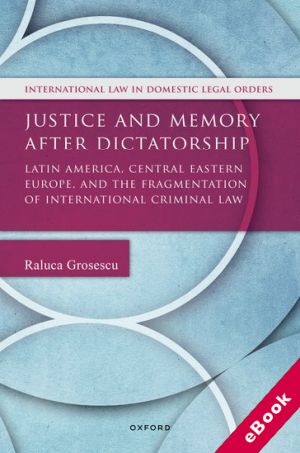
After the fall of military and communist dictatorships at the end of the 1980s, Latin American and Eastern European countries had to reckon with atrocities perpetrated by these Cold War regimes. Judges, prosecutors, and human rights campaigners across the two regions constructed novel readings of international criminal law to fight impunity and realize justice for gross human rights violations.
Justice and Memory after Dictatorship: Latin America, Central Eastern Europe and the Fragmentation of International Criminal Law provides a groundbreaking socio-historical account of the global transformation of international criminal law from these two semi-peripheries of the world system. Based on ethnographic observation and analyses of jurisprudence, Raluca Grosescu dissects the narratives that were fundamentally shaped by the relationship of law and politics.
Using paradigmatic cases and personal interviews with lawyers and judicial officials from Latin America and Eastern Europe, Grosescu uncovers how legal actors and organizations were instrumental in questioning an international order that marginalized the political violence that had unfolded in the two regions during the Cold War. Justice and Memory after Dictatorship is a significant volume in modern international criminal and human rights law and an important read for scholars, students, and legal practitioners alike.










