
The eBooks we sell are sold as a single-user licence and are intended for the end user only.
The sale of some eBooks are restricted to certain countries. To alert you to such restrictions, please select the country of the billing address of your credit or debit card you wish to use for payment.
For further information see https://www.wildy.com/ebook-formats
Once the order is confirmed an e-mail will be sent to you to allow you to download the eBook. For UK purchases this will be automatic. For purchases outside the UK a member of staff will need to confirm the sale. (Staff are available to do this during normal business hours, Mon-Fri 8:30-17:00 UK time)
All eBooks are supplied firm sale and cannot be returned. If you believe there is a fault with your eBook then contact us on ebooks@wildy.com and we will help in resolving the issue. This does not affect your statutory rights.
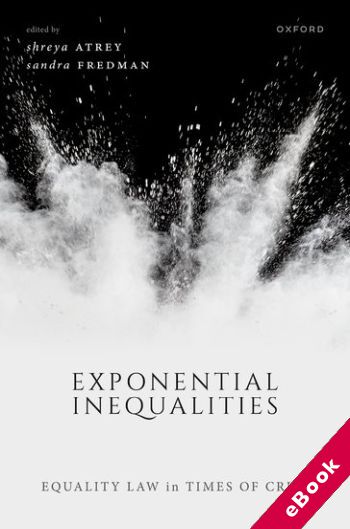
This thoughtfully edited volume explores the operation of equality and discrimination law in times of crisis. It aims to understand how existing inequalities are exacerbated in crises and whether equality law has the tools to understand and address this contingency.
Experience during the COVID-19 crisis shows that the pandemic has acted as a catalyst for 'exponential inequalities' related to racism, xenophobia, sexism, homophobia, transphobia, ageism, and ableism. Yet, the field of equality law (which is meant to be addressing such discrimination or inequality) has had little immediate relevance in mitigating these exponential inequalities. This is despite the fact that countries like the UK have a rather recent and state-of-the-art legislation in the field, namely the Equality Act 2010.
Exponential Inequalities offers readers an understanding of how these inequalities came to be and how crises such as the global pandemic, the climate emergency, or the economic downturn, can exacerbate an already untenable situation. It illuminates both the structural and the conceptual, as well as the practical and doctrinal difficulties currently experienced in equality law, and discusses whether or not equality law even has the tools to both understand and then address this contingency.
Written by a team of internationally recognized experts, Exponential Inequalities provides a comparative perspective on the functioning of equality laws across a range of contexts and jurisdictions and represents an essential read for scholars and policy makers alike.











