
The eBooks we sell are sold as a single-user licence and are intended for the end user only.
The sale of some eBooks are restricted to certain countries. To alert you to such restrictions, please select the country of the billing address of your credit or debit card you wish to use for payment.
For further information see https://www.wildy.com/ebook-formats
Once the order is confirmed an e-mail will be sent to you to allow you to download the eBook. For UK purchases this will be automatic. For purchases outside the UK a member of staff will need to confirm the sale. (Staff are available to do this during normal business hours, Mon-Fri 8:30-17:00 UK time)
All eBooks are supplied firm sale and cannot be returned. If you believe there is a fault with your eBook then contact us on ebooks@wildy.com and we will help in resolving the issue. This does not affect your statutory rights.
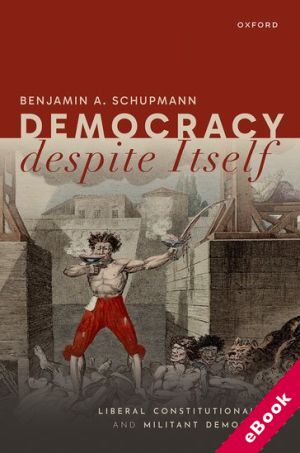
Recent developments, including anti-democratic moves by governments in Hungary, India, and Turkey and the rise of populist leaders, demonstrate the threat posed to democratic values by legal revolution and other acts committed within the confines of the system. Militant democracy, a form of constitutional entrenchment, can protect these values from the harmful influence of illiberal regimes. However, critics and proponents alike wonder whether these tactics risk undermining democracy in the process of trying to save it.
Democracy despite Itself advances a liberal normative theory of militant democracy by combining American philosopher John Rawls' political liberalism with German jurist Carl Schmitt's state theory. It argues for the adoption of three constitutional mechanisms of militant democracy-explicit unamendability, political rights restrictions, and the guardianship of a constitutional court-to prevent the subversion and erosion of democracy by the abuse of legal measures. Rawls' thought provides the substantive democratic content of this theory, establishing basic liberal rights as a precondition for legitimate government. Schmitt's thought provides the militant political form, justifying the state's use of proactive militant measures to preserve the political identity of its constitution.
This blending of works by two thinkers rarely regarded as complementary is a novel approach that offers a compelling vision for how liberal democracy can be protected from anti-democratic actors.>











