
The eBooks we sell are sold as a single-user licence and are intended for the end user only.
The sale of some eBooks are restricted to certain countries. To alert you to such restrictions, please select the country of the billing address of your credit or debit card you wish to use for payment.
For further information see https://www.wildy.com/ebook-formats
Once the order is confirmed an e-mail will be sent to you to allow you to download the eBook. For UK purchases this will be automatic. For purchases outside the UK a member of staff will need to confirm the sale. (Staff are available to do this during normal business hours, Mon-Fri 8:30-17:00 UK time)
All eBooks are supplied firm sale and cannot be returned. If you believe there is a fault with your eBook then contact us on ebooks@wildy.com and we will help in resolving the issue. This does not affect your statutory rights.
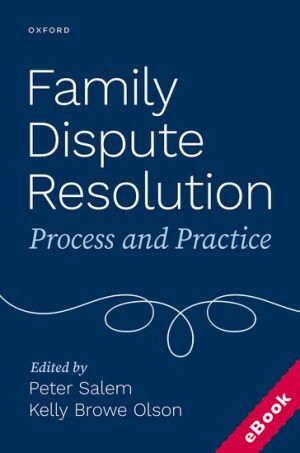
Over the last 50 years family justice systems in the United States and elsewhere have evolved from a predominant adversarial approach focused on litigation to the significant integration of more collaborative, settlement-oriented approaches, especially mediation. In Family Dispute Resolution: Process and Practice some of the field's leading practitioners, researchers, teachers, and policymakers provide an overview of the modern family dispute resolution processes designed to help separating and divorcing parents make decisions about the future of their families.
Chapters in this book address the growth of divorce mediation and other specialized processes including parenting coordination, arbitration, child-inclusive mediation, and online dispute resolution. They describe how to work with families experiencing issues including domestic violence, high conflict, substance misuse, and the lack of legal representation. Case management initiatives and special issues, including social science research and conflicting standards of practice, are also explored.
Family Dispute Resolution provides a wide-ranging look at contemporary family dispute resolution processes and is essential reading for everyone interested in learning more about working with separating and divorcing families, including professionals, and law and graduate students.










