
Wildy Logo
(020) 7242 5778
enquiries@wildy.com

Book of the Month

Cover of Housing Law Handbook

Housing Law Handbook

Price: £85.00

Planning Law:
A Practitioner's Handbook
2nd ed


 William Webster, Robert Weatherley


Welcome to Wildys

Watch


Judicial Cooperation in Commercial Litigation 3rd ed (The British Cross-Border Financial Centre World)


 Ian Kawaley, David Doyle, Shade Subair Williams


Offers for Newly Called Barristers & Students

Special Discounts for Newly Called & Students

Read More ...


Secondhand & Out of Print

Browse Secondhand Online

Read More...


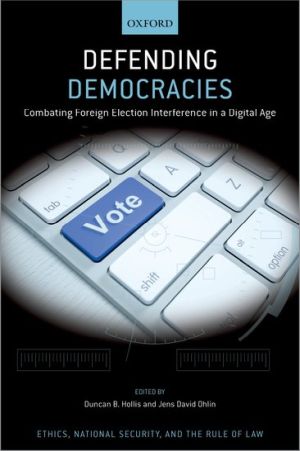
Defending Democracies: Combating Foreign Election Interference in a Digital Age

Edited by: Jens David Ohlin, Duncan B. Hollis

ISBN13: 9780197556979
To be Published: June 2026
Publisher: Oxford University Press
Country of Publication: UK
Format: Hardback
Price:


Election interference is one of the most widely discussed international phenomena of the last five years. Russian covert interference in the 2016 U.S. Presidential Election elevated the topic into a national priority, but that experience was far from an isolated one. Evidence of election interference by foreign states or their proxies has become a regular feature of national elections and is likely to get worse in the near future. Information and communication technologies afford those who would interfere with new tools that can operate in ways previously unimaginable: Twitter bots, Facebook advertisements, closed social media platforms, algorithms that prioritize extreme views, disinformation, misinformation, and malware that steals secret campaign communications.

Defending Democracies examines the problem through an interdisciplinary lens and focuses on: (i) defining the problem of foreign election interference, (ii) exploring the solutions that international law might bring to bear, and (iii) considering alternative regulatory frameworks for understanding and addressing the problem. The result is a deeply urgent examination of an old problem on social media steroids, one that implicates the most central institution of liberal democracy: elections.

The volume seeks to bring domestic and international perspectives on elections and election law into conversation with other disciplinary frameworks, escaping the typical biases of lawyers who prefer international legal solutions for issues of international relations. Taken together, the chapters in this volume represent a more faithful representation of the broad array of solutions that might be deployed, including international and domestic, legal and extra-legal, ambitious and cautious.


Subjects:
Public International Law
Contents:
Introduction
Duncan B. Hollis and Jens David Ohlin

I. Election Interference by Foreign Powers: Understanding Its History and its Harm(s)
Chapter 1. Should we worry about partisan electoral interventions? The nature, history, and known effects of foreign interference in elections
Dov H. Levin
Chapter 2. Understanding Disinformation Operations in the 21st Century
Steven J. Barela and Jérôme Duberry
Chapter 3. Weaponizing Information Systems for Political Disruption
Valeria Marcia and Kevin C. Desouza
Chapter 4. Protecting Democracy by Commingling Polities: The Case for Accepting Foreign Influence and Interference in Democratic Processes
Duncan MacIntosh

II. Understanding Election Interference via a Comparative Lens
Chapter 5. The Specter of Chinese Interference: Examining Beijing's Inroads into India's Digital Spaces and Political Activity
Arun Mohan Sukumar and Akhil Deo
Chapter 6. A Swedish Perspective on Foreign Election Interference
Alicia Fjällhed, James Pamment, and Sebastian Bay
Chapter 7. When Does Election Interference Via Cyberspace Violate Sovereignty?
James Van de Velde

III. Combatting Foreign Election Interference under International Law
Chapter 8. Foreign Election Interference and International Law
Chimène Keitner
Chapter 9. Cybersecurity Abroad: Election Interference and the Extraterritoriality of Human Rights Treaty Obligations
Ido Kilovaty
Chapter 10. The Dangers of Forceful Countermeasures as a Response to Cyber Election Interference
Jacqueline Van de Velde
Chapter 11. Election Interference: A Unique Harm Requiring Unique Solutions
Jens David Ohlin
Chapter 12. The Free Speech Blind Spot: Foreign Election Interference on Social Media
Evelyn Douek

IV. Combatting Foreign Election Interference Through Other Means
Chapter 13. Foreign Election Interference and Open-Source Anarchy
David P. Fidler
Chapter 14. Defending Democracies via Cybernorms
Duncan B. Hollis and Jan Neutze
Chapter 15. Using Campaign Finance Reform to Protect U.S. Elections from 'Dark Money' and Foreign Influence
Ian Vandewalker and Lawrence Norden
Chapter 16. Conclusions
Herb Lin







