
The eBooks we sell are sold as a single-user licence and are intended for the end user only.
The sale of some eBooks are restricted to certain countries. To alert you to such restrictions, please select the country of the billing address of your credit or debit card you wish to use for payment.
For further information see https://www.wildy.com/ebook-formats
Once the order is confirmed an e-mail will be sent to you to allow you to download the eBook. For UK purchases this will be automatic. For purchases outside the UK a member of staff will need to confirm the sale. (Staff are available to do this during normal business hours, Mon-Fri 8:30-17:00 UK time)
All eBooks are supplied firm sale and cannot be returned. If you believe there is a fault with your eBook then contact us on ebooks@wildy.com and we will help in resolving the issue. This does not affect your statutory rights.
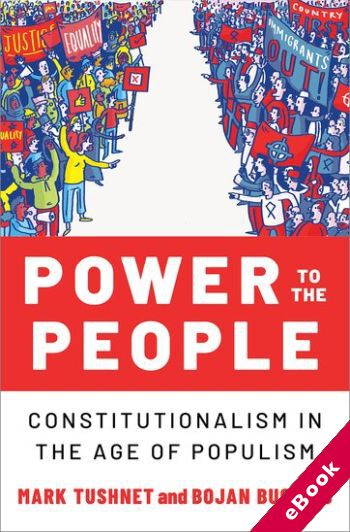
Self-described populist leaders around the world are dismantling their nation's constitutions. This has led to a widespread view that populism as such is inconsistent with constitutionalism. This book proposes that some forms of populism are inconsistent with constitutionalism, while others aren't. Context and detail matter.
Power to the People offers a thin definition of constitutionalism that people from the progressive left to the conservative right should be able to agree on even if they would supplement the thin definition withn other more partisan ideas. This is followed by a similarly basic definition of populism. Comparing the two, this book argues that one facet of populism -its suspicion of institutions that are strongly entrenched against change by political majorities-is sometimes inconsistent with constitutionalism'sbthinly understood definition.
The book provides a series of case studies, some organized by nation, others by topic, to identify, more precisely, when and how populist programs are inconsistent with constitutionalism-and, importantly, when and how they are not. Concluding with a discussion of the possibilities for a deeper, populist democracy, the book examines recent challenges to the idea that democracy is a good form of government by exploring possibilities for new, albeit revisable, institutions that can determine and implement a majority's views without always threatening constitutionalism.











