
The eBooks we sell are sold as a single-user licence and are intended for the end user only.
The sale of some eBooks are restricted to certain countries. To alert you to such restrictions, please select the country of the billing address of your credit or debit card you wish to use for payment.
For further information see https://www.wildy.com/ebook-formats
Once the order is confirmed an e-mail will be sent to you to allow you to download the eBook. For UK purchases this will be automatic. For purchases outside the UK a member of staff will need to confirm the sale. (Staff are available to do this during normal business hours, Mon-Fri 8:30-17:00 UK time)
All eBooks are supplied firm sale and cannot be returned. If you believe there is a fault with your eBook then contact us on ebooks@wildy.com and we will help in resolving the issue. This does not affect your statutory rights.
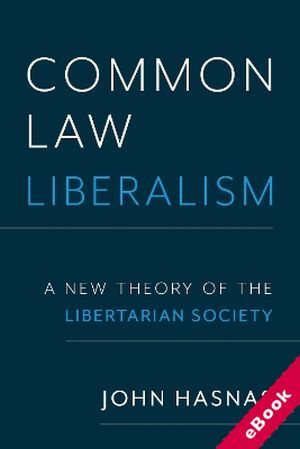
In conventional political philosophy, law is understood as consciously created rules that are a necessary mechanism for regulating the excesses of the free market. Although coercive in nature, law is seen as a necessary defense against anarchy. But is the situation that simple? In his examination of the purpose and functioning of the legal system, John Hasnas challenges this false dichotomy, presenting a new theory of liberalism that demonstrates that the common law can serve as an effective alternative to traditional politically created legislation.
Hasnas argues that there are options beyond the unregulated market or a market regulated by consciously created government law. Instead, he suggests, law can arise through a process of unplanned evolution in which those subject to law are bound, but not by the will of any identifiable human beings. Anglo-American common law, which evolved without a guiding human intelligence, showcases this. Over the centuries of its development, the common law process created the rules of contract, property, tort, and commercial law that define key aspects of liberal society. Common law's decentralized and continually evolving nature renders it resistant to political rent-seeking and responsive to changing economic and social conditions--allowing it to adapt to the needs of those it serves to protect, rather than to the desires of a powerful few.
Hasnas suggests that while the enforcement of law may involve coercion, law in and of itself is not destined to be a vehicle for domination. Common Law Liberalism demonstrates that the common law can provide all rules necessary to sustain a peaceful, prosperous, liberal society--without intervention by politically created legislation and the exploitation and oppression it so often engenders.











