
The eBooks we sell are sold as a single-user licence and are intended for the end user only.
The sale of some eBooks are restricted to certain countries. To alert you to such restrictions, please select the country of the billing address of your credit or debit card you wish to use for payment.
For further information see https://www.wildy.com/ebook-formats
Once the order is confirmed an e-mail will be sent to you to allow you to download the eBook. For UK purchases this will be automatic. For purchases outside the UK a member of staff will need to confirm the sale. (Staff are available to do this during normal business hours, Mon-Fri 8:30-17:00 UK time)
All eBooks are supplied firm sale and cannot be returned. If you believe there is a fault with your eBook then contact us on ebooks@wildy.com and we will help in resolving the issue. This does not affect your statutory rights.
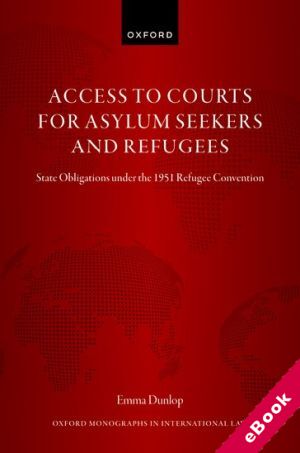
In Ensuring Access to Courts for Asylum Seekers and Refugees, Emma Dunlop focuses on the scope and content of article 16 of the 1951 Refugee Convention. Under this article, States are obligated to provide asylum seekers and refugees with access to courts. This obligation entails a requirement to ensure 'effective' access, which may call for accommodations to be made to address individual vulnerabilities -where, for example, a person does not speak the language of the court or lacks easy access to a lawyer. It also guarantees additional rights to those who have attained 'habitual residence' in the host country.
Access to courts is a critical gateway right, the denial of which can prevent a person from defending other rights under domestic law. Yet, until now, article 16 has not received extensive scrutiny.
In the first dedicated monograph on article 16 of the 1951 Convention, Dunlop positions the article within the broader context of international human rights law, customary international law, and general principles of law, presenting a comprehensive account of asylum seekers' and refugees' right of access to courts. Taking an evolutionary approach to treaty interpretation, the book interrogates the scope and content of the article, evaluating the extent of its obligations. Despite developments in international human rights law since the article's adoption, Access to Courts for Asylum Seekers and Refugees argues that it remains a relevant and robust source of protection. Offering rigorous and reasoned analysis of this critical provision, Dunlop advances a principled approach to interpreting article 16.










