
The eBooks we sell are sold as a single-user licence and are intended for the end user only.
The sale of some eBooks are restricted to certain countries. To alert you to such restrictions, please select the country of the billing address of your credit or debit card you wish to use for payment.
For further information see https://www.wildy.com/ebook-formats
Once the order is confirmed an e-mail will be sent to you to allow you to download the eBook. For UK purchases this will be automatic. For purchases outside the UK a member of staff will need to confirm the sale. (Staff are available to do this during normal business hours, Mon-Fri 8:30-17:00 UK time)
All eBooks are supplied firm sale and cannot be returned. If you believe there is a fault with your eBook then contact us on ebooks@wildy.com and we will help in resolving the issue. This does not affect your statutory rights.
Due to a technical issue some ebooks are not available to order.
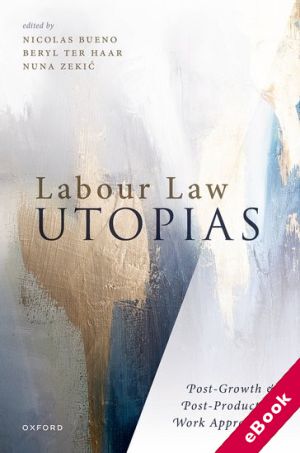
Labour Law Utopias: Post-Growth & Post-Productive Work Approaches engages with new socioeconomic ideas that look beyond the current growth-driven competitive market economy. Building on analysis of economic growth, as well as the limits of the logic of human productivity and competitivity for workers and the environment, it explores alternative approaches and what those will mean for work in general, and labour law in particular.
The concept of 'post-growth' is used to rethink the purpose of the economy by looking beyond merely increasing wealth, consumption, and production, considering what this means for the position of work in society as well as the individual worker. The post-productive work approach is used to question the centrality of economically productive work and its regulation in labour laws. The chapters in this book take a progressive approach and discuss whether and how labour law can contribute to the emancipation of work from the constraints of growth and productivity by revisiting the value, organization, and impact of work. With these utopian ideas for labour law, the contributions in this book present inspirational 'dots on the horizon' that could guide the direction of changes in labour law as it navigates issues such as the implementation of digital and green solutions, the energy crisis, migration, rising inequality, and precariousness.










