
The eBooks we sell are sold as a single-user licence and are intended for the end user only.
The sale of some eBooks are restricted to certain countries. To alert you to such restrictions, please select the country of the billing address of your credit or debit card you wish to use for payment.
For further information see https://www.wildy.com/ebook-formats
Once the order is confirmed an e-mail will be sent to you to allow you to download the eBook. For UK purchases this will be automatic. For purchases outside the UK a member of staff will need to confirm the sale. (Staff are available to do this during normal business hours, Mon-Fri 8:30-17:00 UK time)
All eBooks are supplied firm sale and cannot be returned. If you believe there is a fault with your eBook then contact us on ebooks@wildy.com and we will help in resolving the issue. This does not affect your statutory rights.
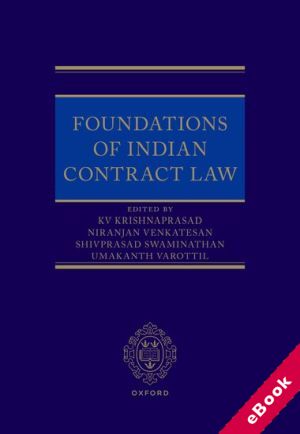
This new volume analyses the central doctrines and concepts of Indian contract law and provides guidance on the interpretation of the Indian Contract Act 1872 by examining its historical, philosophical, and comparative foundations.
Featuring contributions from practitioners and academics from around the world, the book follows a methodology carefully calibrated to address the shortcomings in traditional Indian contract law scholarship. The primary presuppositions of this methodology are that: (a) the answers to many difficult questions of Indian contract law can be found in the history of the Contract Act; and (b) while it is difficult to understand the Contract Act other than against the backdrop of the common law, one should not assume that Indian contract law mirrors the common law on all difficult points. Each chapter therefore pays close attention to the legislative history of the relevant provision(s) of the Contract Act.
Formed of 24 chapters and a conclusion by Professor Hugh Beale (former Commercial Law and Common Law Commissioner at the Law Commission of England and Wales), the volume presents an authoritative exposition of a branch of the law that is of considerable interest and great practical importance for practitioners, scholars, and students interested in Indian contract law.










