
The eBooks we sell are sold as a single-user licence and are intended for the end user only.
The sale of some eBooks are restricted to certain countries. To alert you to such restrictions, please select the country of the billing address of your credit or debit card you wish to use for payment.
For further information see https://www.wildy.com/ebook-formats
Once the order is confirmed an e-mail will be sent to you to allow you to download the eBook. For UK purchases this will be automatic. For purchases outside the UK a member of staff will need to confirm the sale. (Staff are available to do this during normal business hours, Mon-Fri 8:30-17:00 UK time)
All eBooks are supplied firm sale and cannot be returned. If you believe there is a fault with your eBook then contact us on ebooks@wildy.com and we will help in resolving the issue. This does not affect your statutory rights.
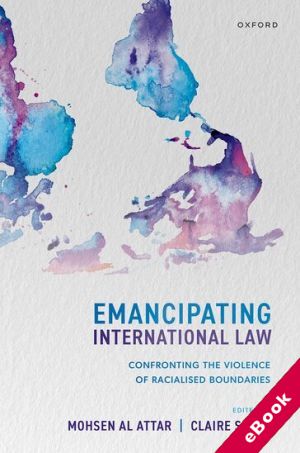
While mainstream international legal scholarship has long treated race as a peripheral concern-or a historic injustice to be remembered but not redressed-this volume argues that racialisation is foundational to the discipline, underpinning its doctrines, epistemes, and interlocutors. Emancipating International Law explores the many ways racial hierarchy, systemic oppression, and global white supremacy shape international law. Bringing together leading and emerging scholars, the collection moves beyond qualifying whether international law is racist to explore how racial hierarchies are embedded in its structures and continue to evolve through legal and institutional practice.
Divided into five sections, the book begins by situating international law's racialised boundaries within its colonial, capitalist, and chauvinist afterlives, exposing how white ignorance and race-thinking underpin legal norms, from sovereignty to jus cogens. It then examines racial stratification across legal institutions, including investment law, refugee law, and the Genocide Convention. The third section extends this critique to human rights, revealing the ways in which even an emancipatory paradigm can bolster racial injustices. The penultimate section unpacks racial hierarchies in disparate societies, including Brazil, India, and Japan, as well as the frontiers of nation-states. The volume concludes with a powerful discussion of the role of activism and alternative epistemologies in racial justice struggles, and the limits of international law's capacity for anti-racist transformation.
Aimed at scholars, practitioners, and students of international law, critical legal studies, and anti-colonial theory, this book advances an understanding of international law that is aimed at dismantling its racialised structures.
This is an open access title available under the terms of a CC BY-NC-ND 4.0 International licence. It is free to read on Oxford Scholarship Online and offered as a free PDF download from OUP and selected open access locations.










