
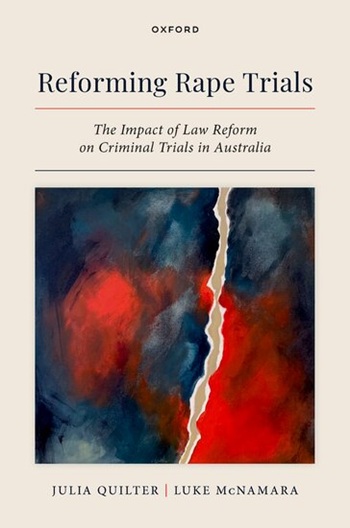
Despite fifty years of "progressive" rape law reform in Australia and across the common law world, victim-survivors of sexual violence continue to express disappointment and distress when they seek justice through the criminal courts.
Reforming Rape Trials examines why. Drawing on rare access to tens of thousands of pages of transcripts from more than 100 rape trials in New South Wales and Victoria, the authors reveal a significant gap between the rhetoric of reform and the realities of courtroom practice. Complainants are still routinely accused of lying and are interrogated for not behaving as a supposedly "genuine" victim should. These questioning practices remain deeply shaped by rape myths and stereotypes that are both harmful and empirically unfounded.
Departing from earlier scholarship, which has largely attributed ongoing problems to failures of implementation by lawyers, judges, and juries, the book argues that the issues run deeper. The persistence of rape-myth reasoning and character attacks is not simply a failure of courtroom actors to adapt; it stems from the fact that policymakers and legislators have never genuinely attempted to eliminate these practices. Modern reform efforts often prioritize complex statutory definitions of consent and detailed jury directions. Yet these tools do little to transform the parts of the trial that most urgently require change-particularly cross-examination strategies steeped in outdated and misleading assumptions about sexual violence.
The authors conclude that meaningful justice for victim-survivors requires a broader rethinking of law reform. Central to this is confronting the expansive notion of "relevant" evidence, which currently allows rape myths to enter the courtroom under the guise of probative value. They argue that an accused person's criminal responsibility can — and must — be assessed without relying on evidence that perpetuates myths that have no legitimate role in twenty-first-century trials.
This is an open access title. It is available to read and download as a free PDF version on Oxford Academic and is made available under a Creative Commons Attribution-Non Commercial-No Derivatives 4.0 International licence.










