
The eBooks we sell are sold as a single-user licence and are intended for the end user only.
The sale of some eBooks are restricted to certain countries. To alert you to such restrictions, please select the country of the billing address of your credit or debit card you wish to use for payment.
For further information see https://www.wildy.com/ebook-formats
Once the order is confirmed an e-mail will be sent to you to allow you to download the eBook. For UK purchases this will be automatic. For purchases outside the UK a member of staff will need to confirm the sale. (Staff are available to do this during normal business hours, Mon-Fri 8:30-17:00 UK time)
All eBooks are supplied firm sale and cannot be returned. If you believe there is a fault with your eBook then contact us on ebooks@wildy.com and we will help in resolving the issue. This does not affect your statutory rights.
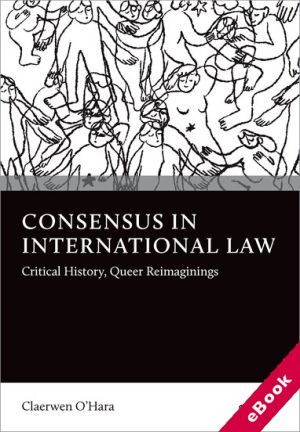
Consensus in International Law: Critical History, Queer Reimaginings critically explores the idea of 'consensus' by retracing its history in two settings: in consensus decision-making in the General Agreement on Tariffs and Trade and World Trade Organisation, and the European Court of Human Rights' use of 'European consensus' as a method of treaty interpretation. Employing a unique theoretical framework informed by queer theory and jurisdictional thinking, the book argues that consensus in international law is best understood as a technique of authorization, which functions by gesturing towards a widespread, yet unfixed, level of agreement.
Claerwen O'Hara demonstrates that the gesture towards widespread agreement works to imbue institutional practices with an air of equality and project visions of unity onto a decision, helping to ground the authority of international institutions and their legal worlds. At the same time, the variable nature of the agreement means that the idea of consensus can be applied flexibly, including in situations in which no such equality or unity exists. Consequently, despite the positive discourses surrounding the idea of consensus in international law, it has often worked to suppress difference and dissent and uphold existing power relations. The book suggests that this gap between discourse and reality has been a contributing factor in some of the problems facing international law and its institutions today. To overcome these problems, Consensus in International Law calls for a shift in imagination in which the idea of the world or a particular region routinely reaching a widespread agreement is decentred in international law. In its place, the book proposes a vision of the international as a 'meeting place' for a plurality of peoples and their laws.










