
The eBooks we sell are sold as a single-user licence and are intended for the end user only.
The sale of some eBooks are restricted to certain countries. To alert you to such restrictions, please select the country of the billing address of your credit or debit card you wish to use for payment.
For further information see https://www.wildy.com/ebook-formats
Once the order is confirmed an e-mail will be sent to you to allow you to download the eBook. For UK purchases this will be automatic. For purchases outside the UK a member of staff will need to confirm the sale. (Staff are available to do this during normal business hours, Mon-Fri 8:30-17:00 UK time)
All eBooks are supplied firm sale and cannot be returned. If you believe there is a fault with your eBook then contact us on ebooks@wildy.com and we will help in resolving the issue. This does not affect your statutory rights.
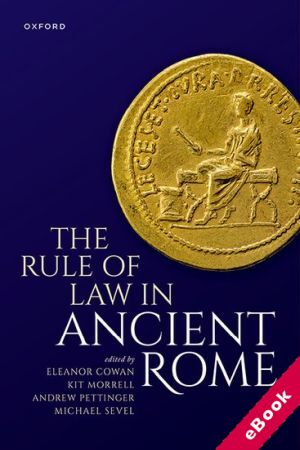
The ideal of the rule of law - that the law should protect all citizens from arbitrary exercises of power - can be traced from ancient Greece to the present day. The Roman contribution to the rule of law tradition has been largely overlooked, however, both in rule-of-law scholarship and recent considerations of Roman law.
This volume - the first of its kind - brings together the study of the rule of law and the study of ancient Rome. Its chapters apply insights and approaches drawn from modern legal theory in order to understand the ways in which Romans thought about law and the place of law in their community, the ways in which Roman institutions and political norms protected citizens against the arbitrary exercise of power, and how these ideas and practices changed with Rome's transition from republic to empire. Together, the contributors turn a new spotlight on the community of the Romans by asking whether and to what extent Rome may be said to have invested in the idea and practice of 'the rule of law', and how the rule of law intersected with other values including justice, popular sovereignty, and the personal authority of the emperor. At the same time, the volume seeks to enrich current thinking on the rule of law by providing an evidence-rich case-study of ancient Rome during the republic and empire.
Recent years have witnessed increasing attacks on the rule of law, including attacks arising within liberal democracies and their institutions. It is a crucial time to be thinking about the rule of law. Deepening our historical understanding through close study of the rule of law in Rome is both timely and necessary.










