The eBooks we sell are sold as a single-user licence and are intended for the end user only.
The sale of some eBooks are restricted to certain countries. To alert you to such restrictions, please select the country of the billing address of your credit or debit card you wish to use for payment.
For further information see https://www.wildy.com/ebook-formats
Once the order is confirmed an e-mail will be sent to you to allow you to download the eBook. For UK purchases this will be automatic. For purchases outside the UK a member of staff will need to confirm the sale. (Staff are available to do this during normal business hours, Mon-Fri 8:30-17:00 UK time)
All eBooks are supplied firm sale and cannot be returned. If you believe there is a fault with your eBook then contact us on ebooks@wildy.com and we will help in resolving the issue. This does not affect your statutory rights.
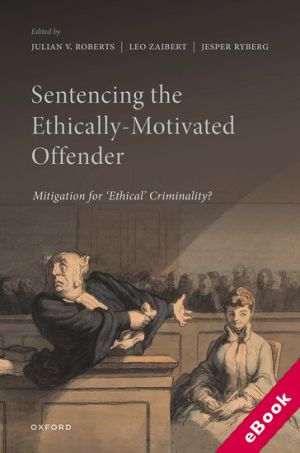
From climate change protests in the West, to pro-democracy demonstrations in Asia, in recent years we have witnessed a global rise in offending motivated by a 'just cause'. This book argues that the conventional criminal law and sentencing frameworks where the offender is seen as malignantly motivated and punished accordingly is inappropriate here. Legislatures, courts, sentencing councils and commissions must now confront the question: should people convicted of ethically-motivated crimes benefit from mitigation at sentencing?
Bringing together contributors from Europe, Asia, and Latin America, Sentencing the Ethically-Motivated Offender: Mitigation for 'Ethical' Criminality? explores various criminal acts which might be perceived to be ethically defensible, and what the appropriate criminal law responses should be. Bridging the gap between theory and practice, the book contains a number of case histories, examining how the courts in a range of countries sentence environmental, political, and other offenders. Part I of the volume addresses a range of cross-cutting questions which apply across many forms of 'ethical offending'. Part II contains a series of jurisdiction-specific analyses which reveal the diversity of approaches to sentencing offenders who act from an honourable motive.
Sitting at the intersection of criminal law, criminal justice and philosophy, this volume represents the first scholarly effort towards clarifying the principles and practices relevant to sentencing the ethically-motivated defendant.