
The eBooks we sell are sold as a single-user licence and are intended for the end user only.
The sale of some eBooks are restricted to certain countries. To alert you to such restrictions, please select the country of the billing address of your credit or debit card you wish to use for payment.
For further information see https://www.wildy.com/ebook-formats
Once the order is confirmed an e-mail will be sent to you to allow you to download the eBook. For UK purchases this will be automatic. For purchases outside the UK a member of staff will need to confirm the sale. (Staff are available to do this during normal business hours, Mon-Fri 8:30-17:00 UK time)
All eBooks are supplied firm sale and cannot be returned. If you believe there is a fault with your eBook then contact us on ebooks@wildy.com and we will help in resolving the issue. This does not affect your statutory rights.
International relations are full of appeals to and claims about international law. From intellectual property, to human rights, to environment, to investment, to health and safety, issues that have traditionally been almost exclusively within the purview of domestic lawmakers are now the subject of international legal obligations. Yet despite the importance of international law, there are no well-developed set of theories on the ways in which international law impacts domestic decision makers.
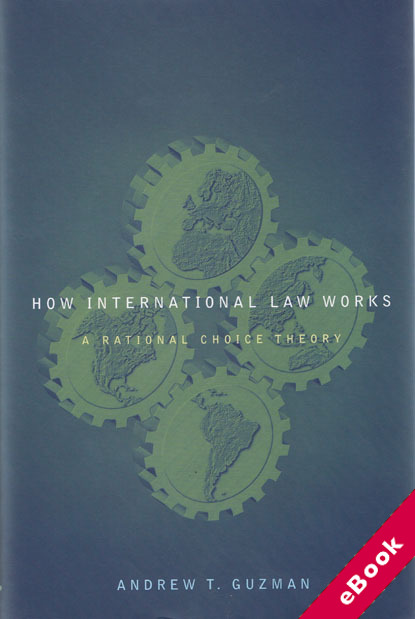
Filling a conspicuous gap in the legal literature, Andrew T. Guzman's How International Law Works develops a coherent theory of international law and applies that theory to the primary sources of law, treaties, customary international law, and soft law. Starting where most non-specialists start, Guzman looks at how a legal system without enforcement tools can succeed. If international law is not enforced through coercive tools, how is it enforced at all? And why would states comply with it?
Supporting the traditional international law view that international law matters and affects state behavior, Guzman offers a theory of international law that assumes states behave rationally and selfishly. The author argues that at the heart of compliance with international law is the basic fact that a failure to live up to legal obligations today will impact a country's ability to extract concessions for legal promises in the future. Under this reputational model, the violation of international law generates a costly loss of reputation and the threat of this loss provides an incentive to comply.
A reputational theory suggests when and where international law is likely to be effective and ways to maximize its ability to advance the goal of international cooperation. Understanding international law in a world of rational states helps us to understand when we can look to international law to resolve problems, and when we must accept that we live in an anarchic world and must leave some issues to politics.











