
The eBooks we sell are sold as a single-user licence and are intended for the end user only.
The sale of some eBooks are restricted to certain countries. To alert you to such restrictions, please select the country of the billing address of your credit or debit card you wish to use for payment.
For further information see https://www.wildy.com/ebook-formats
Once the order is confirmed an e-mail will be sent to you to allow you to download the eBook. For UK purchases this will be automatic. For purchases outside the UK a member of staff will need to confirm the sale. (Staff are available to do this during normal business hours, Mon-Fri 8:30-17:00 UK time)
All eBooks are supplied firm sale and cannot be returned. If you believe there is a fault with your eBook then contact us on ebooks@wildy.com and we will help in resolving the issue. This does not affect your statutory rights.
Due to a technical issue some ebooks are not available to order.
Good lawyers have an ability to tell stories. Whether they are arguing a murder case or a complex financial securities case, they can capably explain a chain of events to judges and juries so that they understand them.
The best lawyers are also able to construct narratives that have an emotional impact on their intended audiences. But what is a narrative, and how can lawyers go about constructing one? How does one transform a cold presentation of facts into a seamless story that clearly and compellingly takes readers not only from point A to point B, but to points C, D, E, F, and G as well?
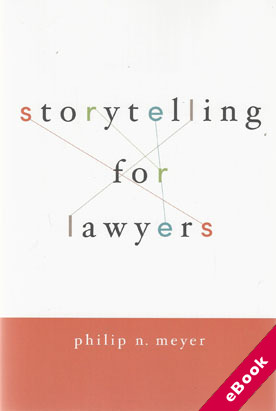
In Storytelling for Lawyers, Phil Meyer explains how. He begins with a pragmatic theory of the narrative foundations of litigation practice and then applies it to a range of practical illustrative examples: briefs, judicial opinions and oral arguments. Intended for legal practitioners, teachers, law students, and even interdisciplinary academics, the book offers a basic yet comprehensive explanation of the central role of narrative in litigation.
The book also offers a narrative tool kit that supplements the analytical skills traditionally emphasized in law school as well as practical tips for practicing attorneys that will help them craft their own legal stories.










