
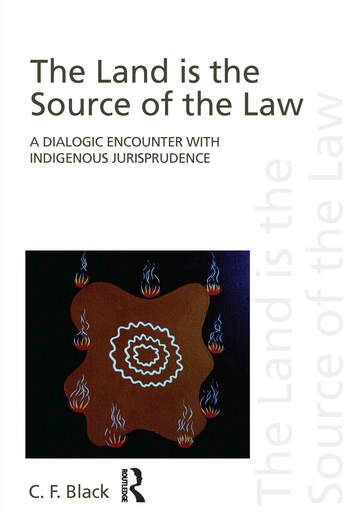
The Land is the Source of Law brings an inter-jurisdictional dimension to the field of indigenous jurisprudence: comparing Indigenous legal regimes in New Zealand, the USA and Australia, it offers a ‘dialogical encounter with an Indigenous jurisprudence’ in which individuals are characterised by their rights and responsibilities into the Land.
Though a relatively "new" field, Indigenous jurisprudence is the product of the oldest continuous legal system in the world. Utilising a range of texts – films, novels, poetry, as well as "law stories" CF Black blends legality and narrative in order to redefine jurisprudentia in Indigenous terms. This re-definition gives shape to the jurisprudential framework of the book: a shape that is not just abstract, but physical and metaphysical; a shape that is circular and concentric at the same time. The outer circle is the cosmology, so that the human never forgets that they are inside a universe - a universe that has a law. This law is found in the second circle which, whilst resembling the ancient Greek law of physis is a law based on relationship. This is a relationship that orders the placing of the individual in the innermost circle, and which structures their rights and responsibilities into the Land. The jurisprudential texts which inform the theoretical framework of this book bring to our attention the urgent message that the Djang (primordial energy) is out of balance, and that the rebalancing of that Djang is up to the individual through their lawful behaviour, a behaviour which patterns them back into land. Thus, The Land is the Source of the Law concludes not only with a diagnosis of the cause of climate change, but a prescription which offers an alternative legal approach to global health.
C.F. Black is an Aboriginal woman who has studied, taught and written about both Western and Indigenous jurisprudential traditions. Her book will be of considerable importance to those with interests in indigenous law, jurisprudence and knowledge.










