
Wildy Logo
(020) 7242 5778
enquiries@wildy.com

Book of the Month

Cover of Housing Law Handbook

Housing Law Handbook

Price: £85.00

Planning Law:
A Practitioner's
Handbook 2nd ed


 William Webster, Robert Weatherley


Welcome to Wildys

Watch


Corporate Insolvency Practice:
Litigation, Procedure
and Precedents 3rd ed


 Mark Watson-Gandy


Offers for Newly Called Barristers & Students

Special Discounts for Newly Called & Students

Read More ...


Secondhand & Out of Print

Browse Secondhand Online

Read More...


Sorry. Can't find the title you are looking for.

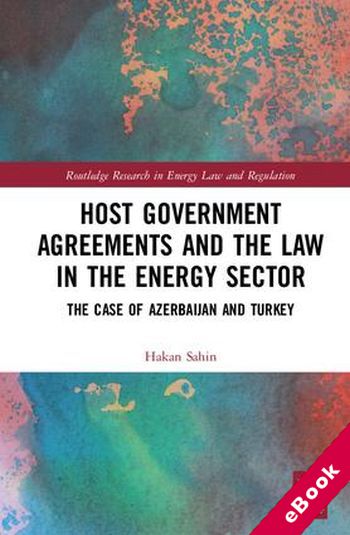
Host Government Agreements and the Law in the Energy Sector: The case of Azerbaijan and Turkey (eBook)


ISBN13: 9780429584794
Published: December 2018
Publisher: Routledge
Country of Publication: UK
Format: eBook (ePub)
Price: £44.99
The amount of VAT charged may change depending on your location of use.

The eBooks we sell are sold as a single-user licence and are intended for the end user only.
The sale of some eBooks are restricted to certain countries. To alert you to such restrictions, please select the country of the billing address of your credit or debit card you wish to use for payment.

For further information see https://www.wildy.com/ebook-formats


Once the order is confirmed an e-mail will be sent to you to allow you to download the eBook. For UK purchases this will be automatic. For purchases outside the UK a member of staff will need to confirm the sale. (Staff are available to do this during normal business hours, Mon-Fri 8:30-17:00 UK time)

All eBooks are supplied firm sale and cannot be returned. If you believe there is a fault with your eBook then contact us on ebooks@wildy.com and we will help in resolving the issue. This does not affect your statutory rights.

This eBook is available in the following formats: ePub.


Due to a technical issue some ebooks are not available to order.

In stock.

Need help with ebook formats?


Also available as

The Energy industry is a key source of growth stimulation for developing states. Understandably, developing states are eager to enter into petroleum investment contracts with international investors, with the expectation that this will benefit their countries. Some developing states’ domestic law provides a welcoming investment environment in the form of guarantees and stability, while others provide these opportunities by agreeing to investment contracts or treaties drafted by international organisations established to facilitate such agreements.

This book determines the political risks, particularly of indirect expropriation, that arise from unilateral actions of host governments during the life span of energy investment projects. Focusing on stabilisation clauses as a political risk manager, it examines what influences host states to agree stability in their long term host governmental agreements. Proposing a framework for the role to be played by both internal forces and external forces, it examines political regimes and state guarantees to foreign investors in Azerbaijan and Turkey from a comparative perspective, assessing how effective internal factors in Azerbaijan and Turkey are in facilitating contractual stability in their energy investment projects.

Providing a comprehensive analysis of stabilization clauses and the internal and external factors that compel host states to commit to them, this book will appeal to practitioners, students and scholars in international investment law and energy law.


Subjects:
eBooks, Energy and Natural Resources Law
Contents:
Acknowledgements
List of Abbreviations
Part I: Political Risk in the Energy Sector
Chapter 1: General Introduction and Framework of the Research
1. Introduction
2. Expropriation or nationalisation
3. Why are stabilisation clauses a controversial issue?
4. Host government agreements
5. Scope and objectives of the research
6. The gap in conventional Literature
7. Research questions
8. Methodology
9. Overview of Azerbaijan and Turkey
10. Baku-Tbilisi-Ceyhan Crude Oil Pipeline Project: timeline, importance and issues
11. Structure of the book
Bibliography
Chapter 2: Indirect Expropriation
1. Introduction
2. Distinguishing between direct and indirect expropriation
3. The types of host state measures that may constitute indirect expropriation
4. Criteria for distinction between legitimate regulation (non-compensable regulation) and indirect expropriation
5. Sole effect versus police power
6. Bilateral investment treaties in Azerbaijan and Turkey and their treaty provisions concerning indirect expropriation
7. Tools for mitigating indirect expropriation risk
8. Conclusions
Bibliography
Part II: Mitigating political risks through stability provisions
Chapter 3 Stabilisation clauses as a legal tool in the management of political risk
1. Introduction
4. General implications of stabilisation clauses
3. Typologies of stabilisation clauses
4. The legal importance and functional value of stabilisation clauses
5. Do stabilisation provisions constitute a threat to environmental protection and human rights?
6. The BTC Pipeline Project (I): reactions to the project
7. Conclusion
Bibliography
Chapter 4: Lenders, Political Risk Insurers and Credit Rating Agencies
1. Introduction
2. The main financial institutions engaged in project finance
3. The role of lenders in the inclusion of stabilisation clauses
4. Political risk insurance providers
5.The role of political risk insurance providers in the inclusion of stabilisation clauses
6. Credit rating agencies
7. The role of credit rating providers in the inclusion of stabilisation clauses
8. The Baku-Tbilisi-Ceyhan Pipeline Project (II)
9. Conclusions
Bibliography
Chapter 5: Political systems and laws on foreign investment in Azerbaijan and Turkey
1. Introduction
2. Azerbaijan
3. Turkey
4. A comparison of the guarantees available under FDI Laws and political regimes in Azerbaijan and Turkey
5. Conclusions
Bibliography
Part III: Conclusion and recommendations
Chapter 6: Conclusions and recommendations
1. Research findings and conclusions
2. Recommendations
INDEX









