
The eBooks we sell are sold as a single-user licence and are intended for the end user only.
The sale of some eBooks are restricted to certain countries. To alert you to such restrictions, please select the country of the billing address of your credit or debit card you wish to use for payment.
For further information see https://www.wildy.com/ebook-formats
Once the order is confirmed an e-mail will be sent to you to allow you to download the eBook. For UK purchases this will be automatic. For purchases outside the UK a member of staff will need to confirm the sale. (Staff are available to do this during normal business hours, Mon-Fri 8:30-17:00 UK time)
All eBooks are supplied firm sale and cannot be returned. If you believe there is a fault with your eBook then contact us on ebooks@wildy.com and we will help in resolving the issue. This does not affect your statutory rights.
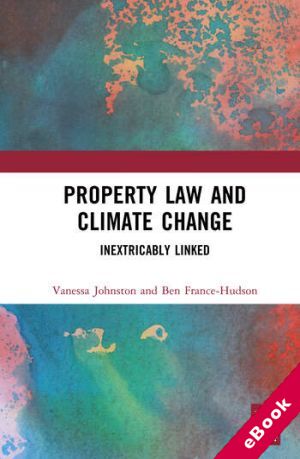
Property Law and Climate Change: Inextricably Linked reveals a critical oversight in global climate action: the failure to integrate property law into climate policy and regulatory frameworks.
Through systematic analysis of mitigation and adaptation strategies, Property Law and Climate Change: Inextricably Linked demonstrates how the neglect of property law fundamentals undermines the effectiveness of climate responses, with particular focus on Australia and New Zealand. The book offers both diagnosis and direction, examining why current approaches fall short and identifying how property law integration could strengthen climate responses. From land use planning to coastal adaptation and carbon sequestration, the authors demonstrate that property law must be integrated within climate change policy. By mapping these crucial connections, this book provides a roadmap for developing regulatory frameworks that work with, rather than against, existing property systems.
This book will appeal to researchers in the fields of property law, environmental law and governance, and comparative law. It will also be of interest to policymakers, lawmakers, urban planners, and legal practitioners.










