
The eBooks we sell are sold as a single-user licence and are intended for the end user only.
The sale of some eBooks are restricted to certain countries. To alert you to such restrictions, please select the country of the billing address of your credit or debit card you wish to use for payment.
For further information see https://www.wildy.com/ebook-formats
Once the order is confirmed an e-mail will be sent to you to allow you to download the eBook. For UK purchases this will be automatic. For purchases outside the UK a member of staff will need to confirm the sale. (Staff are available to do this during normal business hours, Mon-Fri 8:30-17:00 UK time)
All eBooks are supplied firm sale and cannot be returned. If you believe there is a fault with your eBook then contact us on ebooks@wildy.com and we will help in resolving the issue. This does not affect your statutory rights.
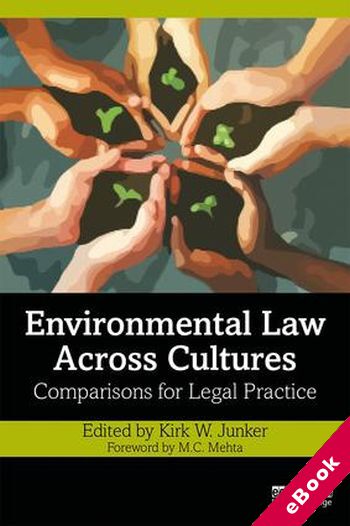
This book provides a practical, functional comparison among various institutions, tools, implementation practices and norms in environmental law across legal cultures.
This is a new approach that focuses on the act of comparison, looking at legal practice, from the ground up, including the perspective of citizens. Most literature on comparative environmental law either focuses on a two-way comparison of state jurisdictions or simply juxtaposes environmental features of two or more state jurisdictions without engaging in any analysis of the comparison. However, this book treats legal cultures as the objects of comparison as it provides practical comparisons among various institutions, tools and norms in environmental law. The arrangement and organisation of the material reverses the more traditional presentation of comparative environmental law as a series of countries within which separate descriptions are respectively presented. In this book the reader is presented with environmental legal themes, with examples and case studies drawn from various cultures that are compared in order to help understand the theme.
Case studies draw on the authors’ experiences in a range of legal cultures, including in Australia, Brazil, China, Chile, Ethiopia, Germany, India, Nigeria, Slovakia and the USA. The comparative nature of the book allows domestic professionals to develop skills to enable them to understand and advocate broader contexts for clients, and helps students become more aware of specific legal systems while questioning why their own system functions (or does not function) as it does.
The book is aimed at advanced undergraduate and postgraduate students of environmental law as well as researchers and practitioners.










