
The eBooks we sell are sold as a single-user licence and are intended for the end user only.
The sale of some eBooks are restricted to certain countries. To alert you to such restrictions, please select the country of the billing address of your credit or debit card you wish to use for payment.
For further information see https://www.wildy.com/ebook-formats
Once the order is confirmed an e-mail will be sent to you to allow you to download the eBook. For UK purchases this will be automatic. For purchases outside the UK a member of staff will need to confirm the sale. (Staff are available to do this during normal business hours, Mon-Fri 8:30-17:00 UK time)
All eBooks are supplied firm sale and cannot be returned. If you believe there is a fault with your eBook then contact us on ebooks@wildy.com and we will help in resolving the issue. This does not affect your statutory rights.
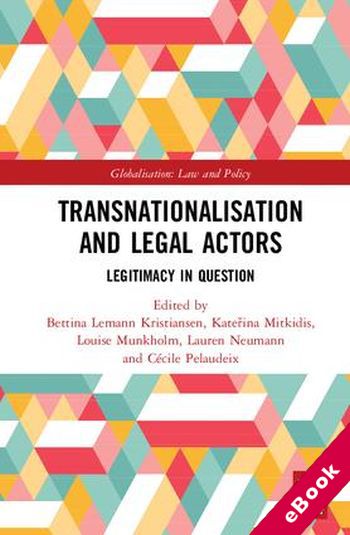
Transnational tendencies have led to a pluralistic legal environment in which emerging and established legal actors, regulatory levels and types of legal norms co-exist, compete and interact in complex ways. This challenges and changes not only how legal norms are created, applied and enforced but also when these actors, norms and processes are considered legitimate.
The book investigates how states and non-state actors interact in transnational settings and pays attention to the understudied question of what effect transnational tendencies have on the legitimacy of legal actors, norms and processes. It seeks to confront three fundamental questions: Has legitimacy significantly changed? Who creates norms and with which consequences for legal procedures and norms? The book considers the question of legitimacy from a broad range of legal perspectives, including environmental law, human rights law and commercial law. It maps out the contours of legitimacy today with an emphasis on the reactions of central actors like states and courts to transnational tendencies.
The book thereby provides a conceptually powerful structure within which to further debate the complexity of transnational tendencies in law and proposes innovative approaches to problem solving while designing pathways for further reflection on the development of law in a transnational context.










