
The eBooks we sell are sold as a single-user licence and are intended for the end user only.
The sale of some eBooks are restricted to certain countries. To alert you to such restrictions, please select the country of the billing address of your credit or debit card you wish to use for payment.
For further information see https://www.wildy.com/ebook-formats
Once the order is confirmed an e-mail will be sent to you to allow you to download the eBook. For UK purchases this will be automatic. For purchases outside the UK a member of staff will need to confirm the sale. (Staff are available to do this during normal business hours, Mon-Fri 8:30-17:00 UK time)
All eBooks are supplied firm sale and cannot be returned. If you believe there is a fault with your eBook then contact us on ebooks@wildy.com and we will help in resolving the issue. This does not affect your statutory rights.
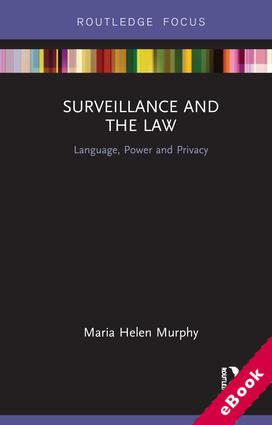
Surveillance of citizens is a clear manifestation of government power. The act of surveillance is generally deemed acceptable in a democratic society where it is necessary to protect the interests of the nation and where the power is exercised non-arbitrarily and in accordance with the law.
Surveillance and the Law analyses the core features of surveillance that create stark challenges for transparency and accountability by examining the relationship between language, power, and surveillance. It identifies a number of features of surveillance law, surveillance language, and the distribution of power that perpetuate the existing surveillance paradigm.
Using case studies from the US, the UK, and Ireland, it assesses the techniques used to maintain the status quo of continued surveillance expansion. These jurisdictions are selected for their similarities, but also for their key constitutional distinctions, which influence how power is distributed and restrained in the different systems.
Though the book maintains that the classic principles of transparency and accountability remain the best means available to limit the arbitrary exercise of government power, it evaluates how these principles could be better realised in order to restore power to the people and to maintain an appropriate balance between government intrusion and the right to privacy.
By identifying the common tactics used in the expansion of surveillance around the globe, this book will appeal to students and scholars interested in privacy law, human rights, information technology law, and surveillance studies.











