
The eBooks we sell are sold as a single-user licence and are intended for the end user only.
The sale of some eBooks are restricted to certain countries. To alert you to such restrictions, please select the country of the billing address of your credit or debit card you wish to use for payment.
For further information see https://www.wildy.com/ebook-formats
Once the order is confirmed an e-mail will be sent to you to allow you to download the eBook. For UK purchases this will be automatic. For purchases outside the UK a member of staff will need to confirm the sale. (Staff are available to do this during normal business hours, Mon-Fri 8:30-17:00 UK time)
All eBooks are supplied firm sale and cannot be returned. If you believe there is a fault with your eBook then contact us on ebooks@wildy.com and we will help in resolving the issue. This does not affect your statutory rights.
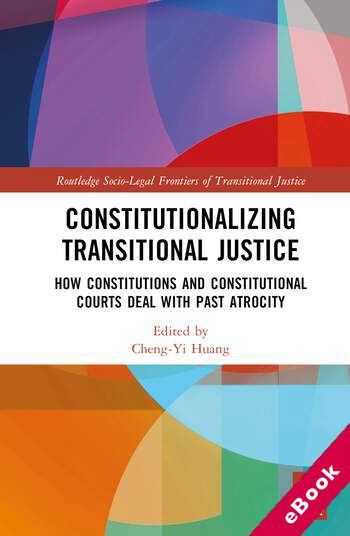
This book explores the complicated relationship between constitutions and transitional justice. It brings together scholars and practitioners from different countries to analyze the indispensable role of constitutions and constitutional courts in the process of overcoming political injustice of the past. Issues raised in the book include the role of a new constitution for the successful practice of transitional justice after democratization, revolution or civil war, and the difficulties faced by the court while dealing with mass human rights infringements with limited legal tools. The work also examines whether constitutionalizing transitional justice is a better strategy for new democracies in response to political injustice from the past. It further addresses the complex issue of backslides of democracy and consequences of constitutionalizing transitional justice. The group of international authors address the interplay of the constitution/court and transitional justice in their native countries, along with theoretical underpinnings of the success or unfulfilled promises of transitional justice from a comparative perspective.
The book will be a valuable resource for academics, researchers and policy-makers working in the areas of Transitional Justice, Comparative Constitutional Law, Human Rights Studies, International Criminal Law, Genocide Studies, Law and Politics, and Legal History.










