
The eBooks we sell are sold as a single-user licence and are intended for the end user only.
The sale of some eBooks are restricted to certain countries. To alert you to such restrictions, please select the country of the billing address of your credit or debit card you wish to use for payment.
For further information see https://www.wildy.com/ebook-formats
Once the order is confirmed an e-mail will be sent to you to allow you to download the eBook. For UK purchases this will be automatic. For purchases outside the UK a member of staff will need to confirm the sale. (Staff are available to do this during normal business hours, Mon-Fri 8:30-17:00 UK time)
All eBooks are supplied firm sale and cannot be returned. If you believe there is a fault with your eBook then contact us on ebooks@wildy.com and we will help in resolving the issue. This does not affect your statutory rights.
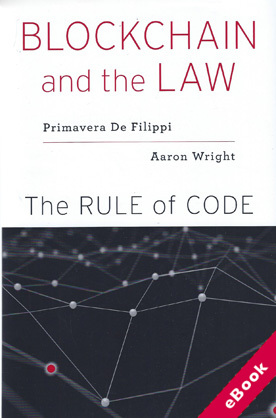
Since Bitcoin appeared in 2009, the digital currency has been hailed as an Internet marvel and decried as the preferred transaction vehicle for all manner of criminals. It has left nearly everyone without a computer science degree confused: Just how do you “mine” money from ones and zeros?
The answer lies in a technology called blockchain, which can be used for much more than Bitcoin. A general-purpose tool for creating secure, decentralized, peer-to-peer applications, blockchain technology has been compared to the Internet itself in both form and impact.
Some have said this tool may change society as we know it. Blockchains are being used to create autonomous computer programs known as “smart contracts,” to expedite payments, to create financial instruments, to organize the exchange of data and information, and to facilitate interactions between humans and machines.
The technology could affect governance itself, by supporting new organizational structures that promote more democratic and participatory decision making.
Primavera De Filippi and Aaron Wright acknowledge this potential and urge the law to catch up. That is because disintermediation—a blockchain’s greatest asset—subverts critical regulation. By cutting out middlemen, such as large online operators and multinational corporations, blockchains run the risk of undermining the capacity of governmental authorities to supervise activities in banking, commerce, law, and other vital areas.
De Filippi and Wright welcome the new possibilities inherent in blockchains. But as Blockchain and the Law makes clear, the technology cannot be harnessed productively without new rules and new approaches to legal thinking.










