
The eBooks we sell are sold as a single-user licence and are intended for the end user only.
The sale of some eBooks are restricted to certain countries. To alert you to such restrictions, please select the country of the billing address of your credit or debit card you wish to use for payment.
For further information see https://www.wildy.com/ebook-formats
Once the order is confirmed an e-mail will be sent to you to allow you to download the eBook. For UK purchases this will be automatic. For purchases outside the UK a member of staff will need to confirm the sale. (Staff are available to do this during normal business hours, Mon-Fri 8:30-17:00 UK time)
All eBooks are supplied firm sale and cannot be returned. If you believe there is a fault with your eBook then contact us on ebooks@wildy.com and we will help in resolving the issue. This does not affect your statutory rights.
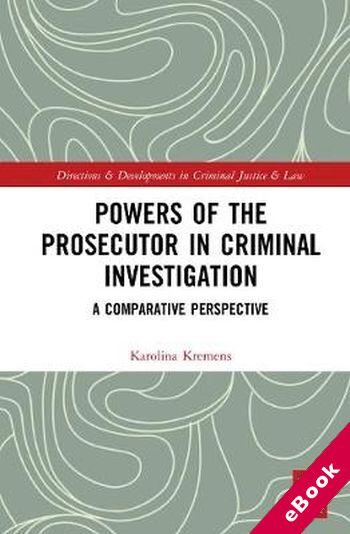
This comparative analysis examines the scope of prosecutorial powers at different phases of criminal investigation in four countries: the United States, Italy, Poland, and Germany. In all of these countries, where the majority of cases are decided by forms of adjudication in which judges are often called to just confirm agreements achieved between parties, the criminal investigation has become a central point of the criminal process. It is important to make a conscience determination regarding who shall be in charge of this stage of the process. Prosecutors have gained tremendous powers to influence the outcome of the criminal cases, including powers once reserved only for judges. The book attempts to answer the question of whether in the system in which the role of the trial is diminishing, and where the significance of criminal investigation is constantly growing, should the powers of the prosecutor at the early stage of the process be enhanced.
Using a problem-oriented approach that begins with the identification of a problem and then looks for potential common solutions, the book provides a parallel analysis of each country along five possible spheres of prosecutorial engagement: commencing criminal investigation, conducting criminal investigation, undertaking the initial charging decision, imposing coercive measures and discontinuing criminal investigation. Using the competing models of the adversarial versus inquisitorial approach as a framework, the focus is on the prosecutor as a crucial figure of criminal process and investigation to various degrees in different systems.
The insights of this comparative treatment are relevant to students and academics in criminal justice, criminology, law, and public policy, as well as policymakers, government officials, and others interested in legal reform.











