
The eBooks we sell are sold as a single-user licence and are intended for the end user only.
The sale of some eBooks are restricted to certain countries. To alert you to such restrictions, please select the country of the billing address of your credit or debit card you wish to use for payment.
For further information see https://www.wildy.com/ebook-formats
Once the order is confirmed an e-mail will be sent to you to allow you to download the eBook. For UK purchases this will be automatic. For purchases outside the UK a member of staff will need to confirm the sale. (Staff are available to do this during normal business hours, Mon-Fri 8:30-17:00 UK time)
All eBooks are supplied firm sale and cannot be returned. If you believe there is a fault with your eBook then contact us on ebooks@wildy.com and we will help in resolving the issue. This does not affect your statutory rights.
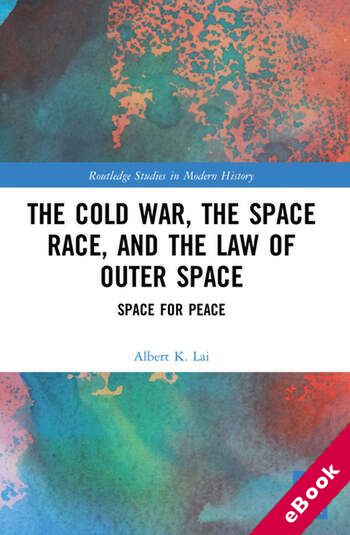
The Cold War, the Space Race, and the Law of Outer Space: Space for Peace tells the story of one of the United Nations’ most enduring and least known achievements: the adoption of five multilateral treaties that compose the international law of outer space.
The story begins in 1957 during the International Geophysical Year, the largest ever cooperative scientific endeavor that resulted in the launch of Sputnik. Although satellites were first launched under the auspices of peaceful scientific cooperation, the potentially world-ending implications of satellites and the rockets that carried them was obvious to all. By the 1960s, the world faced the prospect of nuclear testing in outer space, the placement of weapons of mass destruction in orbit, and the militarization of the moon. This book tells the story of how the United Nations tried to seize the promise of peace through scientific cooperation and to ward off the potential for war in the Space Age through the adoption of the Outer Space Treaty, the Rescue and Return Agreement, the Liability Convention, the Registration Convention, and the Moon Agreement.
Interdisciplinary in approach, the book will be of interest to scholars in law, history and other fields who are interested in the Cold War, the Space Race, and outer space law.










