
The eBooks we sell are sold as a single-user licence and are intended for the end user only.
The sale of some eBooks are restricted to certain countries. To alert you to such restrictions, please select the country of the billing address of your credit or debit card you wish to use for payment.
For further information see https://www.wildy.com/ebook-formats
Once the order is confirmed an e-mail will be sent to you to allow you to download the eBook. For UK purchases this will be automatic. For purchases outside the UK a member of staff will need to confirm the sale. (Staff are available to do this during normal business hours, Mon-Fri 8:30-17:00 UK time)
All eBooks are supplied firm sale and cannot be returned. If you believe there is a fault with your eBook then contact us on ebooks@wildy.com and we will help in resolving the issue. This does not affect your statutory rights.
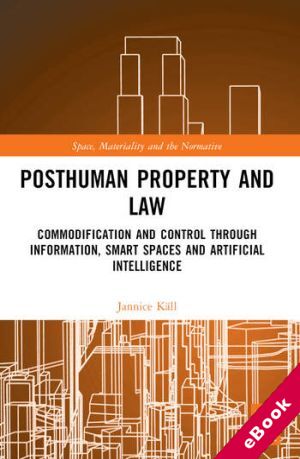
This book analyses the phenomenon of digitally mediated property and considers how it problematises the boundary between human and nonhuman actors.
The book addresses the increasingly porous border between personhood and property in digitized settings and considers how the increased commodification of knowledge makes visible a rupture in the liberal concept of the property owning, free, person. Engaging with the latest work in posthumanist and new materialist theory, it shows, how property as a concept as well as a means for control, changes fundamentally under advanced capitalism. Such change is exemplified by the way in which data, as an object of commodification, is extracted from human activities yet is also directly used to affectively control – or nudge – humans. Taking up a range of human engagements with digital platforms and coded architectures, as well as the circulation of affects through practices of artificial intelligence that are employed to shape behaviour, the book argues that property now needs to be understood according to an ecology of human as well as nonhuman actors. The idea of posthuman property, then, offers both a means to critique property control through digital technologies, as well as to move beyond the notion of the self-owning, object-owning, human.
Engaging the most challenging contemporary technological developments, this book will appeal to researchers in the areas of Law and Technology, Legal Theory, Intellectual Property Law, Legal Philosophy, Sociology of Law, Sociology, and Media Studies.










