
The eBooks we sell are sold as a single-user licence and are intended for the end user only.
The sale of some eBooks are restricted to certain countries. To alert you to such restrictions, please select the country of the billing address of your credit or debit card you wish to use for payment.
For further information see https://www.wildy.com/ebook-formats
Once the order is confirmed an e-mail will be sent to you to allow you to download the eBook. For UK purchases this will be automatic. For purchases outside the UK a member of staff will need to confirm the sale. (Staff are available to do this during normal business hours, Mon-Fri 8:30-17:00 UK time)
All eBooks are supplied firm sale and cannot be returned. If you believe there is a fault with your eBook then contact us on ebooks@wildy.com and we will help in resolving the issue. This does not affect your statutory rights.
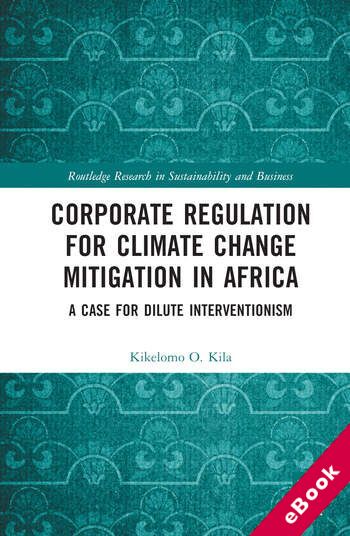
This book critically analyses the prospects of overhauling the legal framework of climate change regulation of corporations in African state. It adopts the 'dilute interventionism' regulatory framework to tackle the culture of regulatory resistance by corporations in Africa.
Over the course of this volume, Kikelomo O. Kila critiques the climate change legal framework in all 53 African states and conducts an in-depth case study of the two largest economies in Africa – Nigeria and South Africa – to highlight the commonality of the problems in Africa and the potential for the 'dilute interventionism' paradigm to significantly address these problems. The book establishes why African states should directly intervene through legislative mechanisms to compel corporations to incorporate climate change mitigation in their business activities. It proposes that this direct intervention should comprise a blend of prescriptive and facilitative mechanisms structured in a 'dilute interventionism' regulatory model. Overall, this volume argues that implementing this model requires the institution of a strong and independent regulator with a 'veto firewall' protection system that guarantees its de facto independence from government and external influences.
Corporate Regulation for Climate Change Mitigation in Africa will be of great interest to climate change stakeholders at the international, regional, and domestic levels, policymakers, regulatory practitioners, and legal experts on corporate regulation. It will also be an insightful resource for students and scholars of climate change and environmental law, policy, and governance.











