
The eBooks we sell are sold as a single-user licence and are intended for the end user only.
The sale of some eBooks are restricted to certain countries. To alert you to such restrictions, please select the country of the billing address of your credit or debit card you wish to use for payment.
For further information see https://www.wildy.com/ebook-formats
Once the order is confirmed an e-mail will be sent to you to allow you to download the eBook. For UK purchases this will be automatic. For purchases outside the UK a member of staff will need to confirm the sale. (Staff are available to do this during normal business hours, Mon-Fri 8:30-17:00 UK time)
All eBooks are supplied firm sale and cannot be returned. If you believe there is a fault with your eBook then contact us on ebooks@wildy.com and we will help in resolving the issue. This does not affect your statutory rights.
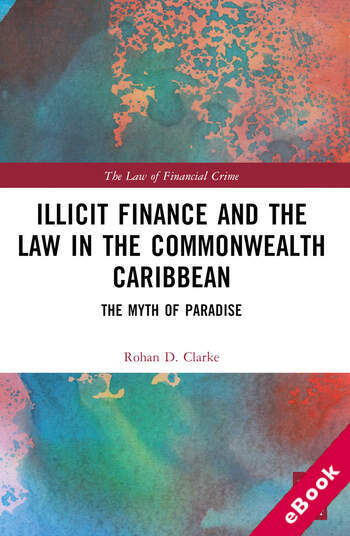
This book provokes fresh ways of thinking about small developing States within the transnational legal order for combating money laundering and the financing of terrorism and proliferation (TAMLO).
From the global wars on drugs and terror to journalistic exposés such as the ‘Paradise’, ‘Panama’ and ‘Pandora’ Papers, the Commonwealth Caribbean has been discursively stigmatised as a mythical island paradise of ‘rogue’ States. Not infrequently, their exercise of regulatory self-determination has been presented as the selling of their economic sovereignty to facilitate shady business deals and illicit finance from high-net-worth individuals, kleptocrats, tax-dodgers, organised crime networks and terrorist financiers. This book challenges conventional wisdom that Commonwealth Caribbean States are among the ‘weakest links’ within the global ecosystem to counter illicit finance. It achieves this by unmasking latent interests, and problematising coercive extraterritorial regulatory and surveillance practices, along the onshore/offshore and Global North/South axes.
Interdisciplinary in its outlook, the book will appeal to policymakers, regulatory and supervisory authorities, academics and students concerned with better understanding legal and development policy issues related to risk-based regulatory governance of illicit finance. The book also provides an interesting exposition of substantive legal and policy issues arising from money laundering related to corruption and politically exposed persons, offshore finance, and offshore Internet gambling services.










