
The eBooks we sell are sold as a single-user licence and are intended for the end user only.
The sale of some eBooks are restricted to certain countries. To alert you to such restrictions, please select the country of the billing address of your credit or debit card you wish to use for payment.
For further information see https://www.wildy.com/ebook-formats
Once the order is confirmed an e-mail will be sent to you to allow you to download the eBook. For UK purchases this will be automatic. For purchases outside the UK a member of staff will need to confirm the sale. (Staff are available to do this during normal business hours, Mon-Fri 8:30-17:00 UK time)
All eBooks are supplied firm sale and cannot be returned. If you believe there is a fault with your eBook then contact us on ebooks@wildy.com and we will help in resolving the issue. This does not affect your statutory rights.
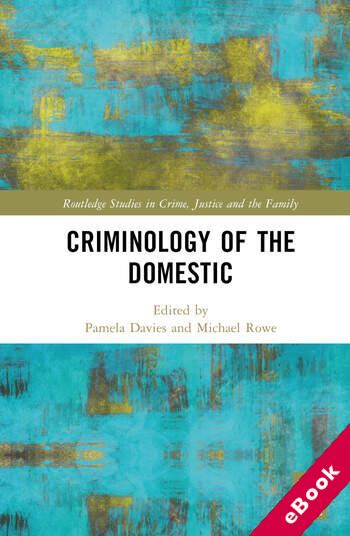
Bringing together a range of perspectives, this book establishes a criminology of the domestic, paying particular attention to emerging spatial and relational reconfigurations. We move beyond criminologies of public and urban domains to consider over-looked non-public locales, and crimes and harms that occur in the home and other private spaces. Developed in the context of the COVID-19 lockdowns, where distinctions between public and private became increasingly untenable, the book considers how the pandemic has accelerated new patterns of behaviour, enabled by technology and shifting social relations.
Drawing on a range of criminological topics, including victimisation, offending, property and violent crime, consumption, deviance and leisure, and zemiology, the book argues that the domestic sphere, and its relation to the public realm, needs to be more carefully conceptualised if criminology is to respond to new spatial and relational dimensions of changing lifestyles.
An accessible and compelling read, this book will appeal to students and scholars of criminology, sociology, politics, geography, history, gender, surveillance and security and all those interested in a criminology of the domestic sphere.











