
The eBooks we sell are sold as a single-user licence and are intended for the end user only.
The sale of some eBooks are restricted to certain countries. To alert you to such restrictions, please select the country of the billing address of your credit or debit card you wish to use for payment.
For further information see https://www.wildy.com/ebook-formats
Once the order is confirmed an e-mail will be sent to you to allow you to download the eBook. For UK purchases this will be automatic. For purchases outside the UK a member of staff will need to confirm the sale. (Staff are available to do this during normal business hours, Mon-Fri 8:30-17:00 UK time)
All eBooks are supplied firm sale and cannot be returned. If you believe there is a fault with your eBook then contact us on ebooks@wildy.com and we will help in resolving the issue. This does not affect your statutory rights.
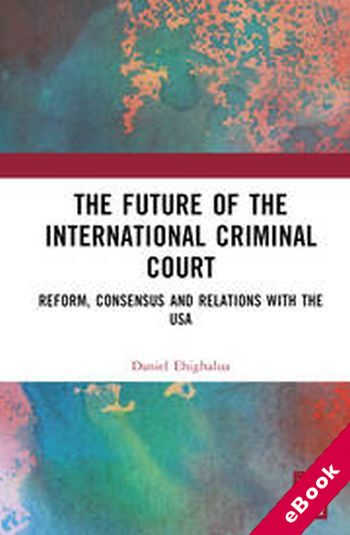
This book presents the argument that solution-driven policy and treaty changes, if faithfully implemented, will rekindle the relevance of the International Criminal Court (ICC) in combatting and prosecuting atrocity crimes. This work examines how the International Criminal Court could be re-envisioned to perform optimally, and why such reform is urgent. It also discusses the position of the USA towards the court and explores why it has been unable to transition from marginal engagement to full spectrum support by signing and ratifying the Rome Treaty 1998. The conceptual frameworks deployed range from how the US construes its ‘national interest’ to geo-political balancing and the present rudderless state of the rules order, in addition to the personal predilections of US Presidents and the Court’s dysfunctional state. The objective is to show that if the ICC does not engender reforms internally, it will not survive the fissiparous tendencies innate in the presently fractured rules order. The work argues that only foundational reforms around treaty amendments along with institutional realignment of roles and responsibilities of the Court’s principal officers will yet rescue it. The book will be of interest to researchers, academics and policy-makers working in the areas of International Criminal Law and International Relations.











