
The eBooks we sell are sold as a single-user licence and are intended for the end user only.
The sale of some eBooks are restricted to certain countries. To alert you to such restrictions, please select the country of the billing address of your credit or debit card you wish to use for payment.
For further information see https://www.wildy.com/ebook-formats
Once the order is confirmed an e-mail will be sent to you to allow you to download the eBook. For UK purchases this will be automatic. For purchases outside the UK a member of staff will need to confirm the sale. (Staff are available to do this during normal business hours, Mon-Fri 8:30-17:00 UK time)
All eBooks are supplied firm sale and cannot be returned. If you believe there is a fault with your eBook then contact us on ebooks@wildy.com and we will help in resolving the issue. This does not affect your statutory rights.
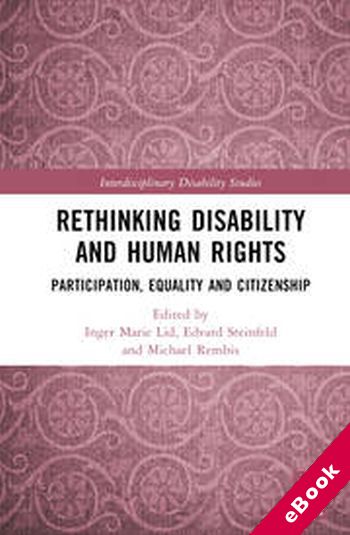
This book examines the role of disability in the right to political and social participation, an act of citizenship that many disabled people do not enjoy.
The disability rights movement does not accept the use of disability to create limits on citizenship, which poses challenges for contemporary societies that will become ever greater as the science and technology of enhancing human abilities evolves. Comprised of eight chapters, four interludes, and a postscript written by leading scholars and disability rights activists, the book explores citizenship for people with disabilities from an interdisciplinary perspective using the Convention on the Rights of People with Disabilities (CRPD) as a point of departure and the concept of universal design as a strategy for actualizing full citizenship for all. Situating disability in its historical and cultural contexts, the authors offer directions for rethinking citizenship, including implications for access to the built environment, information and communication systems, education, work, community life and politics.
This book will be of interest to all scholars and students working in disability studies, planning, architecture, public health, rehabilitation, social work, and education.











