
The eBooks we sell are sold as a single-user licence and are intended for the end user only.
The sale of some eBooks are restricted to certain countries. To alert you to such restrictions, please select the country of the billing address of your credit or debit card you wish to use for payment.
For further information see https://www.wildy.com/ebook-formats
Once the order is confirmed an e-mail will be sent to you to allow you to download the eBook. For UK purchases this will be automatic. For purchases outside the UK a member of staff will need to confirm the sale. (Staff are available to do this during normal business hours, Mon-Fri 8:30-17:00 UK time)
All eBooks are supplied firm sale and cannot be returned. If you believe there is a fault with your eBook then contact us on ebooks@wildy.com and we will help in resolving the issue. This does not affect your statutory rights.
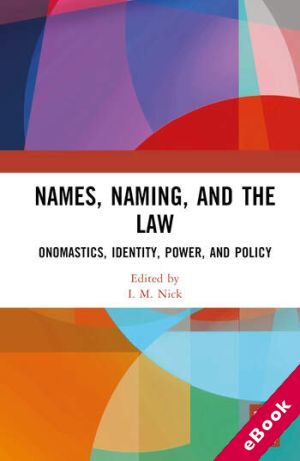
Across many social and commercial domains, governments regulate the official names used to identify individuals, groups, places, companies & products, and even diseases. This innovative volume investigates the relationship between names and the law, with its significant implications for identity (individual, familial, race, ethnicity, gender, species, brand & product industry, etc.) and status (social, scientific, economic, and political).
I. M. Nick introduces the state of the art on this interdisciplinary topic¾ providing a diachronic and synchronic view of onomastics and the law¾ and expert contributors examine seminal Anglo-American legal cases to demonstrate how name polices relate to broader questions of power, privilege, and politics. Each chapter offers an overview of key issues in onomastics and language policy across multiple geo-cultural contexts, and applies the interdisciplinary insights to real-world policies.
This book is a valuable resource for scholars of legal linguistics, forensic linguistics, onomastics, language policy, and cultural studies.










