
The eBooks we sell are sold as a single-user licence and are intended for the end user only.
The sale of some eBooks are restricted to certain countries. To alert you to such restrictions, please select the country of the billing address of your credit or debit card you wish to use for payment.
For further information see https://www.wildy.com/ebook-formats
Once the order is confirmed an e-mail will be sent to you to allow you to download the eBook. For UK purchases this will be automatic. For purchases outside the UK a member of staff will need to confirm the sale. (Staff are available to do this during normal business hours, Mon-Fri 8:30-17:00 UK time)
All eBooks are supplied firm sale and cannot be returned. If you believe there is a fault with your eBook then contact us on ebooks@wildy.com and we will help in resolving the issue. This does not affect your statutory rights.
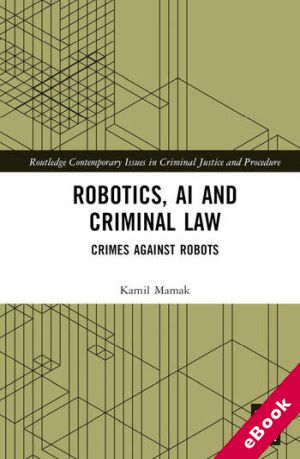
This book offers a phenomenological perspective on the criminal law debate on robots. Today, robots are protected in some form by criminal law. A robot is a person’s property and is protected as property. This book presents the different rationale for protecting robots beyond the property justification based on the phenomenology of human-robot interactions. By focusing on robots that have bodies and act in the physical world in social contexts, the work provides an assessment of the issues that emerge from human interaction with robots, going beyond perspectives focused solely on artificial intelligence (AI). Here, a phenomenological approach does not replace ontological concerns, but complements them. The book addresses the following key areas: Regulation of robots and AI; Ethics of AI and robotics; and philosophy of criminal law.
It will be of interest to researchers and academics working in the areas of Criminal Law, Technology and Law and Legal Philosophy.











