
The eBooks we sell are sold as a single-user licence and are intended for the end user only.
The sale of some eBooks are restricted to certain countries. To alert you to such restrictions, please select the country of the billing address of your credit or debit card you wish to use for payment.
For further information see https://www.wildy.com/ebook-formats
Once the order is confirmed an e-mail will be sent to you to allow you to download the eBook. For UK purchases this will be automatic. For purchases outside the UK a member of staff will need to confirm the sale. (Staff are available to do this during normal business hours, Mon-Fri 8:30-17:00 UK time)
All eBooks are supplied firm sale and cannot be returned. If you believe there is a fault with your eBook then contact us on ebooks@wildy.com and we will help in resolving the issue. This does not affect your statutory rights.
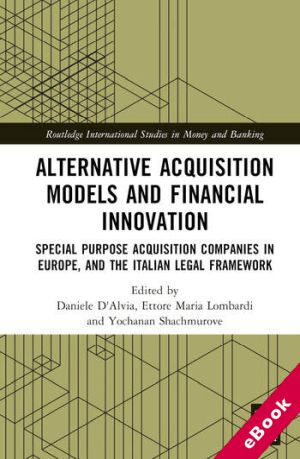
This is the first book in English on SPACs in the context of European and Italian Financial Law, introducing the topic with a general overview at the European level. It is also the first book on the European financial regulation of SPACs. As such, it is a ground-breaking reference book for SPAC studies, at the international level.
It offers the most comprehensive overview of the current international financial regulation of SPACs in the European Union and the United Kingdom (U.K.) against the main legal system where SPAC originates: the United States (U.S.). The edited book is focusing on finding a European legal framework for SPACs by discovering whether the Alternative Investment Fund Managers Directive (AIFMD) or the Undertakings for the Collective Investment in Transferable Securities Directive (UCITS) are applicable to them or not, and why; and identifying the objectives of financial regulation of SPACs both in the European Union, the U.S. and the U.K.
Essentially, the edited collection explores soft law and self-regulation instances against the State-based Westphalian approaches that are centred on hard law instances; describes practical examples of SPACs in Italy and Europe, and it analyses the limits and perspectives of such investment vehicles on the Italian Capital Market as well as their possible use as a form of shadow banking and venture companies at international level.











