The eBooks we sell are sold as a single-user licence and are intended for the end user only.
The sale of some eBooks are restricted to certain countries. To alert you to such restrictions, please select the country of the billing address of your credit or debit card you wish to use for payment.
For further information see https://www.wildy.com/ebook-formats
Once the order is confirmed an e-mail will be sent to you to allow you to download the eBook. For UK purchases this will be automatic. For purchases outside the UK a member of staff will need to confirm the sale. (Staff are available to do this during normal business hours, Mon-Fri 8:30-17:00 UK time)
All eBooks are supplied firm sale and cannot be returned. If you believe there is a fault with your eBook then contact us on ebooks@wildy.com and we will help in resolving the issue. This does not affect your statutory rights.
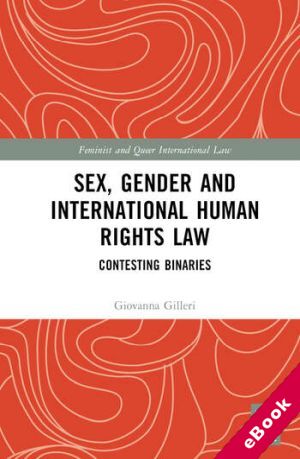
This book investigates the relationship between sex and gender under international human rights law, and how this influences the formation of individual subjects.
Combining feminist, queer and psychoanalytical perspectives, the author scrutinises the sexed/gendered human rights discourse, starting from the assumptions underpinning interpretations of sex, gender, and the related notions of gender identity, sex characteristics and sexual orientation. Human rights law has so far offered only a limited account of the diversity of sexed/gendered subjectivities, being based on a series of simplistic assumptions. Namely, that: there are only two sexes and two genders; that sex is a natural fact and gender is a social construct; that gender is the metonymic signifier for women; and that gender power relations take the asymmetrical shape of male domination versus female oppression. Against these assumptions, dominative and subordinate postures interchangeably attach to femininities and masculinities, depending on the subjects’ roles, their positionalities and the situational meanings of their acts. The limits of an approach to gender which is based on rigid binaries are evident in two case-studies, on the UN human rights treaty bodies’ vocabulary on medically unnecessary interventions upon intersex children, and on the European Court of Human Rights’ narrative on sadomasochism.
This examination of the impact of human rights on gendered subjectivities will be of interest to scholars, students and researchers in international law, gender studies, queer studies, cultural studies, critical race theory and psychoanalysis.