
The eBooks we sell are sold as a single-user licence and are intended for the end user only.
The sale of some eBooks are restricted to certain countries. To alert you to such restrictions, please select the country of the billing address of your credit or debit card you wish to use for payment.
For further information see https://www.wildy.com/ebook-formats
Once the order is confirmed an e-mail will be sent to you to allow you to download the eBook. For UK purchases this will be automatic. For purchases outside the UK a member of staff will need to confirm the sale. (Staff are available to do this during normal business hours, Mon-Fri 8:30-17:00 UK time)
All eBooks are supplied firm sale and cannot be returned. If you believe there is a fault with your eBook then contact us on ebooks@wildy.com and we will help in resolving the issue. This does not affect your statutory rights.
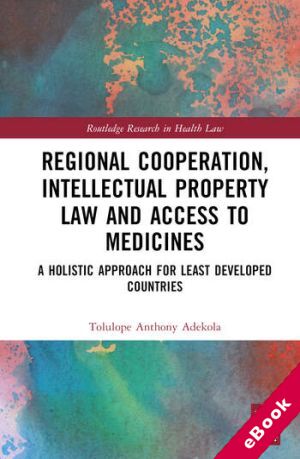
This book examines the potential for regionalization of intellectual property law and policy as a means of improving pharmaceutical access for least developed countries.
The challenge of sustainable access to pharmaceuticals continues to be an issue of global significance. While much has been written on emerging economies in this context, least developed countries have been largely overlooked. This book fills this gap by taking the East African Community as a case study of developing and least developed countries to illustrate why and how a regional collective approach is preferred. It adopts a holistic approach in finding sustainable solutions to both IP and non-IP barriers to pharmaceutical access across a range of inter-related issues through a regional cooperative scheme. It evaluates factors that are necessary for successful regional cooperation, such as legal and policy coherence, WTO rule compliance, the threat of protectionism, regional competition rules, and so on, in order to produce relevant legal and policy recommendations to both existing and intending regional coalitions desiring to improve pharmaceutical access. It also looks beyond the scope of IP barriers to pharmaceutical access, examining non-IP-related factors such as pharmaceutical market intelligence, local pharmaceutical manufacturing capacity, economies of scale and purchasing power, medical regulation and quality assurance, technology transfer, and market size amongst others.
The book will be an invaluable resource for academics, researchers and policy-makers working in the areas of Public Health Law, International Trade Law, Intellectual Property Law and Development Studies.











