
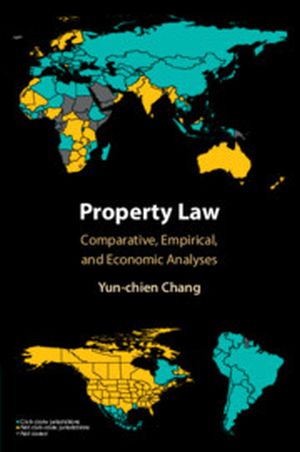
>p>The first book of its kind, Property Law: Comparative, Empirical, and Economic Analyses, uses a unique hand-coded data set on nearly 300 dimensions on the substance of property law in 156 jurisdictions to describe the convergence and divergence of key property doctrines around the world. This book quantitatively analyzes property institutions and uses machine learning methods to categorize jurisdictions into ten legal families, challenging the existing paradigms in economics and law. Using other cross-country data, the author empirically tests theories about property law and comparative law. Using economic efficiency as both a positive and a normative criterion, each chapter evaluates which jurisdictions have the most efficient property doctrines, concluding that the common law is not more efficient than the civil law. Unlike prior studies on empirical comparative law, this book provides detailed citations to laws in each jurisdiction. Data and documentation are publicly available on the author's website.










