
The eBooks we sell are sold as a single-user licence and are intended for the end user only.
The sale of some eBooks are restricted to certain countries. To alert you to such restrictions, please select the country of the billing address of your credit or debit card you wish to use for payment.
For further information see https://www.wildy.com/ebook-formats
Once the order is confirmed an e-mail will be sent to you to allow you to download the eBook. For UK purchases this will be automatic. For purchases outside the UK a member of staff will need to confirm the sale. (Staff are available to do this during normal business hours, Mon-Fri 8:30-17:00 UK time)
All eBooks are supplied firm sale and cannot be returned. If you believe there is a fault with your eBook then contact us on ebooks@wildy.com and we will help in resolving the issue. This does not affect your statutory rights.
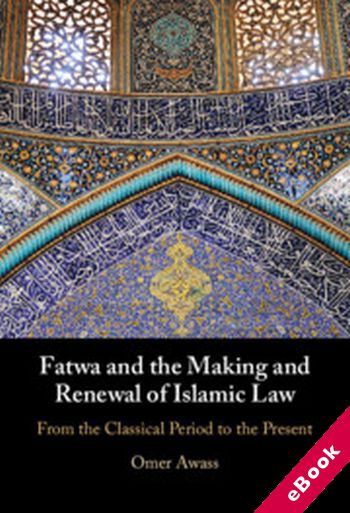
In this book, Omer Awass examines the formation, history, and transformation of the Islamic legal discourse and institutions through the lens of a particular legal practice: the issuance of fatwas (legal opinions). Tracing the growth of Islamic law over a vast geographical expanse -from Andalusia to India - and a long temporal span - from the 7th to the 21st century, he conceptualizes fatwas as the 'atomic units' of Islamic law. Awass argues that they have been a crucial element in the establishment of an Islamic legal tradition. He also provides numerous case studies that touch on economic, social, political, and religious topics. Written in an accessible style, this volume is the first to offer a comprehensive investigation of fatwas within such a broad spatio-temporal scope. It demonstrates how instrumental fatwas have been to the formation of Islamic legal traditions and institutions, as well as their unique forms of reasoning.










