
Wildy Logo
(020) 7242 5778
enquiries@wildy.com

Book of the Month

Cover of McMeel on the Construction of Contracts: Interpretation, Implication and Rectification

McMeel on the Construction of Contracts: Interpretation, Implication and Rectification

Price: £225.00

Land Registration Manual
4th ed


 Ash Jones


Welcome to Wildys

Watch


Judicial Cooperation in Commercial Litigation 3rd ed (The British Cross-Border Financial Centre World)


 Ian Kawaley, David Doyle, Shade Subair Williams


Offers for Newly Called Barristers & Students

Special Discounts for Newly Called & Students

Read More ...


Secondhand & Out of Print

Browse Secondhand Online

Read More...


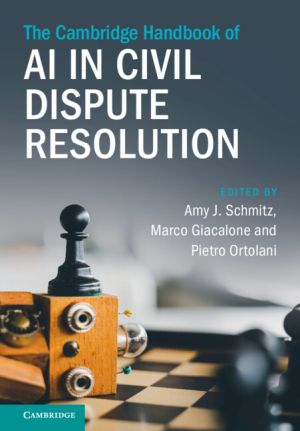
The Cambridge Handbook of AI in Civil Dispute Resolution

Edited by: Amy J. Schmitz, Marco Giacalone, Pietro Ortolani

ISBN13: 9781009589116
To be Published: April 2026
Publisher: Cambridge University Press
Country of Publication: UK
Format: Hardback
Price: £150.00


The Cambridge Handbook of AI in Civil Dispute Resolution

is the first global, in-depth exploration of how artificial intelligence is transforming civil justice. Moving past speculation, it showcases real-world applications-from predictive analytics in Brazil's courts to generative AI in the Dutch legal system and China's AI-driven Internet Courts. Leading scholars and practitioners examine the legal, ethical, and regulatory challenges, including the EU AI Act and emerging governance frameworks. With rich case studies and comparative insights, the book explores AI's impact on access to justice, procedural fairness, and the evolving public–private balance.

Essential reading for legal academics, policymakers, technologists, and dispute resolution professionals, it offers a critical lens on AI's promise-and its limits-in reshaping civil dispute resolution worldwide.


Subjects:
IT, Internet and Artificial Intelligence Law
Contents:
Part I. The State of Play:
1. Responsible use of AI in civil dispute resolution
Amy J. Schmitz
2. Fitting AI within the dispute system design framework
Janet K. Martinez and Grande Lum
3. From AI ethics to AI regulation: emerging regulatory frameworks for AI-enhanced justice
Natali Helberger and Isabella Banks
4. The roles AI is (and should be) playing in dispute resolution: on the legitimacy of AI legal applications
Orna Rabinovich and Talia Schwartz
5. Balancing innovation and ethics: a content analysis of framework documents regulating generative AI in legal practice
Giampiero Lupo

Part II. AI and Public Sector Dispute Resolution:
6. AI governance beyond EO 14110: federal efforts, state regulations, and civil litigation
Iria Giuffrida and Daniel Shin
7. The EU AI act and its effects on AI-enhanced civil justice in Europe
Martin Ebers, Benedikt Quarch and Patrik Rode
8. Artificial Intelligence and international commercial courts
Georgios Dimitropoulos and Umar Azmeh
9. Generative AI and civil justice: towards responsible use in judicial workflows
Anna van Duin and Rachel Rietveld
10. The use of AI in China's internet courts
Chen Lei and Jia Wang
11. Integrating AI in the Brazilian justice system
Roberto Baumgarten Kuster and Elisa Lucena
12. VoorRecht-rechtspraak: enhancing access to justice in the Netherlands with online (supported) dispute resolution
Pieter van Riemsdijk and T. J. Helling
13. The Terminator Judge III: the rise of the machines
Nicolás Lozada, Federico Olsen and Jacobo Gómez

Part. III. AI and Private Sector Dispute Resolution:
14. Integrating AI in mediation
Hannes Westermann
15. The legal validity of the adoption of AI in decision-making in international commercial arbitration
Sarah Hourani
16. AI and arbitration in sub-sahara African countries
Emilia Onyema
17. AI and tools for expanding access to justice
Quinten Steenhuis
18. Contract performance management tools: the monitoring of contracts execution
Silvia Martinelli

Part IV. Lessons for the Future:
19. AI and the public/private divide in civil dispute resolution
Pietro Ortolani
20. AI's role and challenges in shaping the future of arbitration
Maud Piers and Hannah-Carlota Osaer
21. AI and the future of public courts
Nicolas Vermeys and Jinzhe Tan
22. AI and the future of private dispute resolution settlements
Marco Giacalone








