
Due to the current Microsoft incident we are unable to access Email and also the supply of some eBooks may be delayed as well as our ability to process online payments - You can still call the shop on (020) 7242 5778 (08.30-17:00). Last updated 13/11/26 08:00 GMT
The eBooks we sell are sold as a single-user licence and are intended for the end user only.
The sale of some eBooks are restricted to certain countries. To alert you to such restrictions, please select the country of the billing address of your credit or debit card you wish to use for payment.
For further information see https://www.wildy.com/ebook-formats
Once the order is confirmed an e-mail will be sent to you to allow you to download the eBook. For UK purchases this will be automatic. For purchases outside the UK a member of staff will need to confirm the sale. (Staff are available to do this during normal business hours, Mon-Fri 8:30-17:00 UK time)
All eBooks are supplied firm sale and cannot be returned. If you believe there is a fault with your eBook then contact us on ebooks@wildy.com and we will help in resolving the issue. This does not affect your statutory rights.
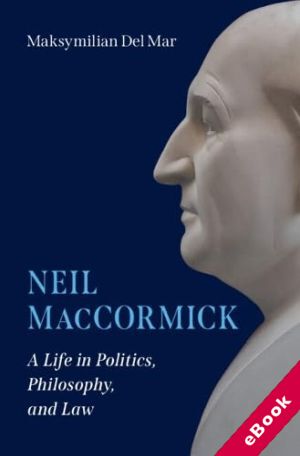
Neil MacCormick (1941–2009) was one of the twentieth century's most important legal philosophers and one of Scotland's most influential public intellectuals. This book tells the story of his political and philosophical life, from his intensely political childhood as the son of 'King John', one of the founders of the Scottish National Party, through to his involvement in Scottish politics – especially as the author of SNP's constitutional policy – and his role as a Member of the European Parliament, helping to draft the European Constitution. With special attention to MacCormick's character, this book offers a reading of his entire oeuvre, covering his contributions to theories of legal and moral reasoning, institutional legal theory, nationalism, post-sovereignty, subsidiarity, and constitutional pluralism in Europe.
This book reads MacCormick as a highly creative thinker who excelled in the art of constructing inclusive middles and thereby developed his own distinctive approach to politics and philosophy.










