
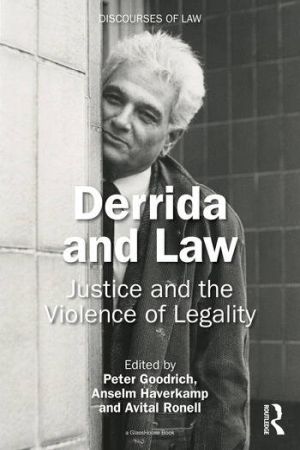
This book brings together an interdisciplinary range of scholars from across the spectrum of disciplines, generations, and geopolitical divides to revisit Jacques Derrida’s account of law, violence and justice.
Deconstruction is variously a philosophy of aporia, a method of patience, a practice of paradoxes, an ontography of uncertainty, a hermeneutics of escalation that sought not only to challenge metaphysical complacencies but also to transgress boundaries, test limits, and above all to provoke, invoke and convoke thought. As a reworking of the philosophical tradition, its impact on law and legal theory became unavoidable in 1989 when Derrida, persuaded by the late Drucilla Cornell, came to address a law school audience on the mystical foundations of law. In a lecture – ‘Force of Law’ – that had global intellectual resonance, he startled the jurists by declaring that deconstruction ‘is’ justice. For some lawyers, it was a landmark thesis, a liberation. For others, it was deemed to be nihilist, a denial of all possibility of meaning, and so denounced as the equivalent of tearing up the constitution, or burning of the flag. Some twenty years after his death, in this book, renowned Derridean scholars revisit this legacy, as it offers a series of re-readings of ‘Force of Law’, and a series of new reflections on Derrida’s account of the violence of legality and the possibility of justice.
This book will appeal to philosophers, legal theorists, and others with an interest in deconstruction and Continental theory.










