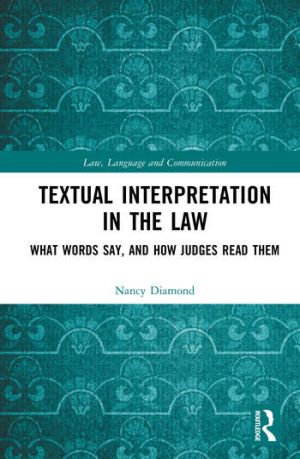
How do courts choose among competing readings of a text? This work draws on linguistics, philosophy of language, hermeneutics, and literary criticism for insights into how texts impart meaning. Through vivid examples and in-depth case studies—of reported judicial decisions rather than stylized hypotheticals—it translates learnings into practical guidance.
Many interpretive disputes arise from ordinary linguistic indeterminacy. Part I develops a taxonomy of linguistic features that create uncertainty, including issues overlooked in legal scholarship. It demonstrates that, despite a rich literature on the very problems that courts grapple with, judges rely primarily on their own intuitions, often reaching conclusions that diverge from current theory. Part II describes processes by which implicit meaning is inferred, and marshals evidence that judicial reasoning reflects these processes. It shows that presuppositional content, though rarely recognized as such, can be outcome-determinative, and challenges the orthodoxy that implicature plays only a minimal role in judicial reasoning.
Readers will emerge with a toolkit—diagnostic tests, checklists, analytic methods, and heuristics—for categorizing linguistic phenomena, resolving ambiguities, and constructing (or spotting fallacies in) text-based arguments. This book will be a valuable resource for academics, researchers, and practitioners—in law, philosophy, pragmatics, communications, and forensic linguistics.