The eBooks we sell are sold as a single-user licence and are intended for the end user only.
The sale of some eBooks are restricted to certain countries. To alert you to such restrictions, please select the country of the billing address of your credit or debit card you wish to use for payment.
For further information see https://www.wildy.com/ebook-formats
Once the order is confirmed an e-mail will be sent to you to allow you to download the eBook. For UK purchases this will be automatic. For purchases outside the UK a member of staff will need to confirm the sale. (Staff are available to do this during normal business hours, Mon-Fri 8:30-17:00 UK time)
All eBooks are supplied firm sale and cannot be returned. If you believe there is a fault with your eBook then contact us on ebooks@wildy.com and we will help in resolving the issue. This does not affect your statutory rights.
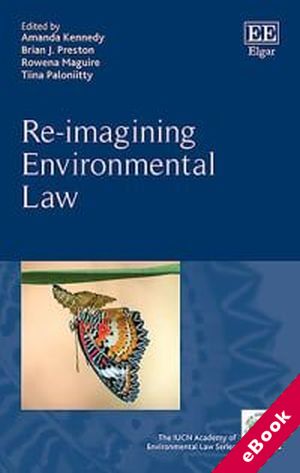
This timely book explores how environmental law must evolve to combat urgent global threats, such as climate change, biodiversity loss, and ecological degradation. In order to effectively mitigate these challenges, the book advocates for holistic, inclusive, and creative solutions that prioritise recovery and regeneration.
Examined through global and interdisciplinary lenses, the chapters cover key ecological concerns including climate justice, indigenous rights, mental health impacts, and governance innovation. Leading experts rethink traditional legal frameworks, proposing adaptive models grounded in community participation and systemic reform. They emphasise justice and inclusivity, highlighting how indigenous knowledge systems, youth advocacy, mental health support, and rights-based approaches will help alleviate the current climate crisis. Re-imagining Environmental Law provides a compelling vision for a legal system that nurtures ecological and social wellbeing, prioritising education, care, and a commitment to planetary health for future generations.
This book is a valuable resource for scholars and students in the fields of environmental law and sustainability studies. The book’s focus on rights, community engagement, and governance innovation will also be of great benefit to policymakers, government advisors, NGOs, and civil society advocates.