
The eBooks we sell are sold as a single-user licence and are intended for the end user only.
The sale of some eBooks are restricted to certain countries. To alert you to such restrictions, please select the country of the billing address of your credit or debit card you wish to use for payment.
For further information see https://www.wildy.com/ebook-formats
Once the order is confirmed an e-mail will be sent to you to allow you to download the eBook. For UK purchases this will be automatic. For purchases outside the UK a member of staff will need to confirm the sale. (Staff are available to do this during normal business hours, Mon-Fri 8:30-17:00 UK time)
All eBooks are supplied firm sale and cannot be returned. If you believe there is a fault with your eBook then contact us on ebooks@wildy.com and we will help in resolving the issue. This does not affect your statutory rights.
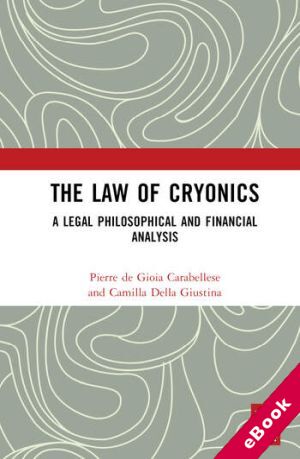
This book, through the lens of interdisciplinary legal analysis, draws a subtle balance between bioethics and financial regulation, with the latter playing an unexpectedly crucial role in the way life may potentially be governed. The legal topic of human preservation or cryo-conservation was initially developed in the USA in the case of Donaldson v van de Kamp. More recently, the subject arose in Europe as a result of a decisum of the High Court, Family Division, in London. This new theme of cryo-conservation has unfolded through multifaceted forms, including its impact on regulation. In an area that may, at least prima facie, be regarded as belonging to the traditional realm of medical law, the findings presented here suggest that its potential has strong economic implications. The work argues that it is necessary also to look at this subject from a more interdisciplinary perspective, drawing a fil rouge between two otherwise seemingly opposing areas of law: medical law and financial regulation.
The legal framework draws on the Anglo-American, and the UK in particular, along with civil law analysis from Italy. The work will be of interest to researchers and academics in the areas of medical law, legal philosophy, financial law, property law and insurance law.











