
The eBooks we sell are sold as a single-user licence and are intended for the end user only.
The sale of some eBooks are restricted to certain countries. To alert you to such restrictions, please select the country of the billing address of your credit or debit card you wish to use for payment.
For further information see https://www.wildy.com/ebook-formats
Once the order is confirmed an e-mail will be sent to you to allow you to download the eBook. For UK purchases this will be automatic. For purchases outside the UK a member of staff will need to confirm the sale. (Staff are available to do this during normal business hours, Mon-Fri 8:30-17:00 UK time)
All eBooks are supplied firm sale and cannot be returned. If you believe there is a fault with your eBook then contact us on ebooks@wildy.com and we will help in resolving the issue. This does not affect your statutory rights.
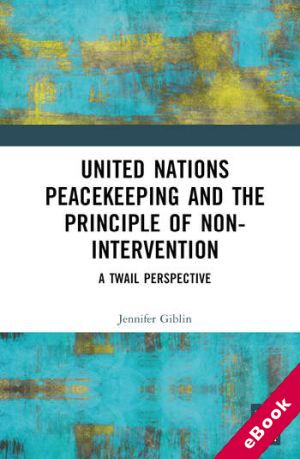
In the unique application of a Third World Approaches to International Law perspective, this book provides a critical, interdisciplinary, examination of the contemporary practice of United Nations peacekeeping.
Is peacekeeping intervention? Since its conception in the mid-1950s, peacekeeping has significantly evolved from traditional, lightly armed, passive operations to robust, multi-dimensional stabilisation peace operations. This raises the question as to whether this is simply a natural evolution of peacekeeping or whether it marks an expansion of the concept of peacekeeping beyond its boundaries, pushing it into the realm of peace enforcement or intervention. In response to this question, this book examines the frameworks which govern United Nations peacekeeping and seeks to understand the relationship between peacekeeping and the principle of non-intervention. Providing practical examples from the UN’s peace operations in the Democratic Republic of the Congo and drawing upon interviews with key international actors including UN personnel, the book explores the boundaries of peacekeeping, contending that peacekeeping, at times, becomes a form of intervention. This, the book argues, is detrimental both to the concept of peacekeeping and to the host state, and it concludes by offering a series of recommendations which could re-affirm peacekeeping’s boundaries and amplify the effectiveness of contemporary peacekeeping.
This book will be of interest to scholars and students in international law, international relations, politics, history and criminology.










