The eBooks we sell are sold as a single-user licence and are intended for the end user only.
The sale of some eBooks are restricted to certain countries. To alert you to such restrictions, please select the country of the billing address of your credit or debit card you wish to use for payment.
For further information see https://www.wildy.com/ebook-formats
Once the order is confirmed an e-mail will be sent to you to allow you to download the eBook. For UK purchases this will be automatic. For purchases outside the UK a member of staff will need to confirm the sale. (Staff are available to do this during normal business hours, Mon-Fri 8:30-17:00 UK time)
All eBooks are supplied firm sale and cannot be returned. If you believe there is a fault with your eBook then contact us on ebooks@wildy.com and we will help in resolving the issue. This does not affect your statutory rights.
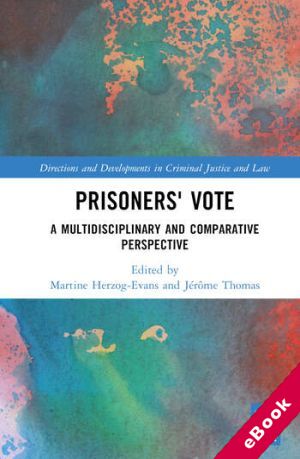
Through different legal and criminological angles and perspectives, this book addresses the controversial question of whether prisoners should have the right to vote, as well as the optimal modalities for such a vote.
By adopting a comparative approach to explore the legal systems of very different jurisdictions, such as the former Eastern Bloc, England, Ireland, the USA and France, the book reveals a recent trend in opening up the right to vote. It also looks at the recommendations of international and European institutions which, while relatively cautious, nevertheless support such progress. Examining the issue from a criminological viewpoint, the book investigates the role that prisoners’ votes could play in the social integration of these individuals into the community through political inclusion as citizens. Offering legal, theoretical and empirical bases, it blends a variety of perspectives to help readers establish an understanding of how prisoners' voting could contribute to improving their attachment to society and its values.
Concise and direct, Prisoners' Vote will be of great interest to upper-level students and scholars of law, criminology, sociology, criminal justice, and political science. It should also appeal to practitioners working in the criminal justice system and policy makers reflecting on whether and how, to open the right to vote to prisoners.