
The eBooks we sell are sold as a single-user licence and are intended for the end user only.
The sale of some eBooks are restricted to certain countries. To alert you to such restrictions, please select the country of the billing address of your credit or debit card you wish to use for payment.
For further information see https://www.wildy.com/ebook-formats
Once the order is confirmed an e-mail will be sent to you to allow you to download the eBook. For UK purchases this will be automatic. For purchases outside the UK a member of staff will need to confirm the sale. (Staff are available to do this during normal business hours, Mon-Fri 8:30-17:00 UK time)
All eBooks are supplied firm sale and cannot be returned. If you believe there is a fault with your eBook then contact us on ebooks@wildy.com and we will help in resolving the issue. This does not affect your statutory rights.
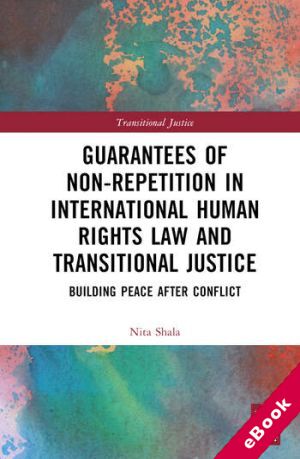
This book examines the understudied, yet increasingly applied, concept of Guarantees of Non-Repetition under international human rights law and transitional justice.
Guarantees of Non-Repetition (GNRs) are measures taken to ensure that human rights abuses do not recur. They are especially crucial in post-war contexts marked by severe and systematic violations. However, although they are increasingly invoked, GNRs are not well understood, and they have so far received only limited theoretical and practical analysis. Tracing their development to the influence of international human rights law, this book considers what GNRs are, how and why they have come about, and how GNRs are implemented. Through an explication of the history, law and jurisprudence of GNR’s – in regional mechanisms in Latin America, Europe, and Asia, as well as in international bodies – the book maintains the increasing importance, and as yet unfulfilled potential, of this legal obligation in transitional justice settings.
This first book to analyse the development of GNRs and their application will appeal to scholars in the areas of law and transitional justice, public policy, and socio-legal studies, as well as lawyers and policy-makers working in post-conflict situations.











