
The eBooks we sell are sold as a single-user licence and are intended for the end user only.
The sale of some eBooks are restricted to certain countries. To alert you to such restrictions, please select the country of the billing address of your credit or debit card you wish to use for payment.
For further information see https://www.wildy.com/ebook-formats
Once the order is confirmed an e-mail will be sent to you to allow you to download the eBook. For UK purchases this will be automatic. For purchases outside the UK a member of staff will need to confirm the sale. (Staff are available to do this during normal business hours, Mon-Fri 8:30-17:00 UK time)
All eBooks are supplied firm sale and cannot be returned. If you believe there is a fault with your eBook then contact us on ebooks@wildy.com and we will help in resolving the issue. This does not affect your statutory rights.
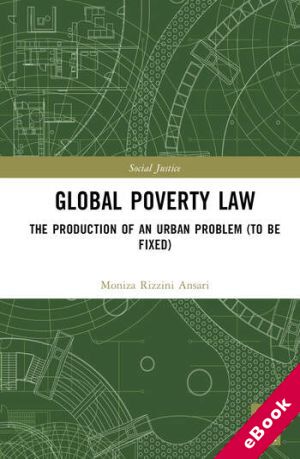
This book demonstrates how the various legal efforts employed to eradicate global urban poverty also play a significant role in shaping it.
Urban poverty has been widely examined as a social problem that requires attention and social commitment. And law is often seen as both an important contributor to the problem, as well as a source of crucial tools to overcome it. In spite of this, however, poverty is surprisingly disregarded within legal scholarship. This book counters this by drawing on legal theory, legal history and legal geography to inquire how urban poverty is made visible and invisible as a problem across global cities. More specifically, it investigates the mechanisms and networks through which global urban poverty has been conceptually and materially shaped in a way that fits the remit of global corporate philanthropy and the development aid agenda. By following law’s circuitous interactions with poverty knowledge and antipoverty interventions, the book demonstrates how it plays a historical role in making poverty seen, known and remedied. As a result, the book argues, law consolidates a stable image of poverty as an essential ‘problem’ – to be uniformly found worldwide, and so reasonably fixable with the appropriate legal reforms. Taking poverty to be a fundamental manifestation of social injustice, the book thus raises key questions about the role of law in the achievement of social justice.
This innovative and insightful account of the relationship between law and poverty will appeal to scholars in critical and socio legal studies, as well as others working in poverty studies, urban studies, development studies, geography, sociology and social policy.











